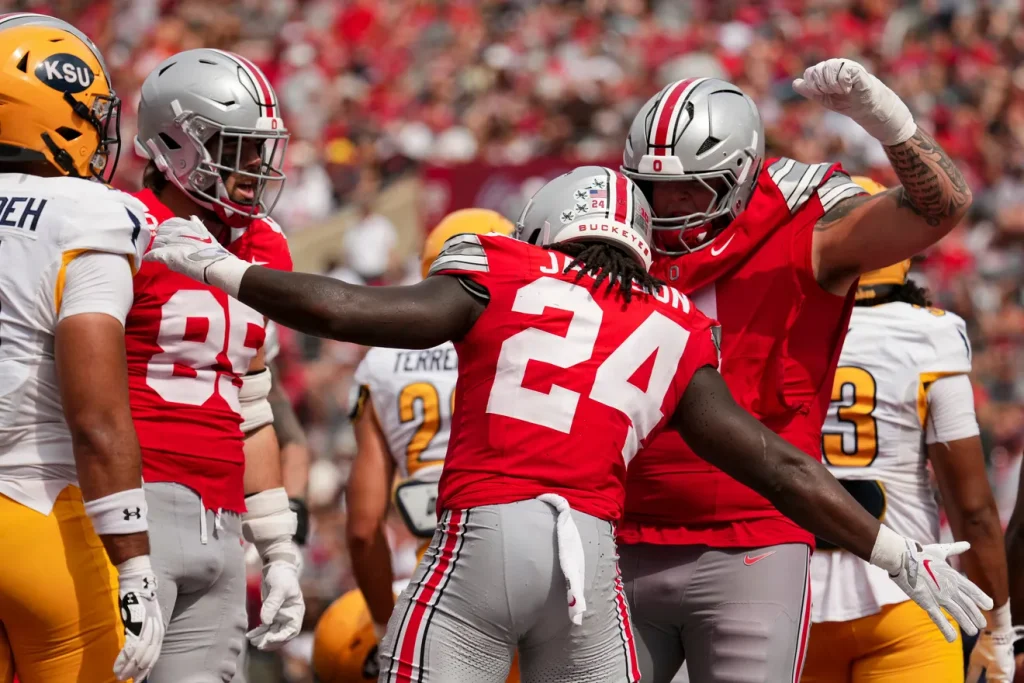
Ryan Day challenges Ohio State’s running backs to run angry as execution, physicality, and short-yardage struggles remain key concerns.
Ohio State’s running game enters Big Ten play with an emphasis on physicality, execution, and maximizing opportunities at the line of scrimmage.
Ryan Day said Tuesday that the Buckeyes missed opportunities against Kent State, including several runs that developed behind open blocking lanes. The issue emerged at the second level, where Ohio State’s running backs failed to turn available space into explosive plays.
“I thought we had some really good big holes in the game and those should have been explosive plays, and they weren’t,” Day said.
Day challenged the running backs to improve their physicality and execution against Illinois.
“We need some dudes who are running angry this week,” Day said.
Ryan Day Challenges Ohio State’s Running Backs
Day identified Ja’Kobi Jackson as the most physical of Ohio State’s running backs against Kent State. He said Bo Jackson and Isaiah West have the ability to produce, while calling for more consistency from both players.
“I thought Ja’Kobi ran harder,” Day said. “That’s just the facts.”
Day’s assessment followed a game in which Ohio State’s running backs had opportunities to make plays beyond the initial point of contact. The coaching staff expects the backs to read their blocks, press the intended running lanes, and finish plays at the second level.
The running scheme also requires different approaches depending on the play. Day said zone concepts require vision and an understanding of how the blocks develop. Gap-scheme runs call for downhill running with limited hesitation.
“You want to be slow to and fast through,” Jackson said. He agreed with Day that the position group needs to improve its execution. He said the running backs’ film session following the Kent State game focused on reading blocks and pressing the holes.
Ja’Kobi Jackson Defines “Running Angry”
Jackson described running angry as avoiding one-on-one tackles in open space.
“Running angry really just looks like not being tackled one-on-one, open field, and winning, making the first guy miss,” Jackson said.
Day identified two ways a running back can finish a play: lowering a shoulder to run through a defender or attacking the defender’s weak shoulder with a stiff arm.
Jackson said his approach centers on running downhill, reaching the end zone, and avoiding tackles by the first defender. The running back also discussed the importance of patience in short-yardage situations. He said backs must identify how defenders fill gaps before accelerating through the opening.
“Slow pace gets you to read what’s going on, where they’re filling the gaps, and being able to move quick off that,” Jackson said.
The approach reflects Day’s expectations for the position. Ohio State’s backs must identify the developing blocks and commit to the running lane.
Short-Yardage Execution Requires Improvement
Ohio State’s running game has also struggled in short-yardage situations. Day said the team aims to convert more than 80% of its short-yardage opportunities, with 90% representing the preferred standard. The Buckeyes currently fall below that level.
He cited breakdowns in the C and D gaps during recent short-yardage attempts. Day said Ohio State needs better angles, improved execution, and a review of how it places players in those situations.
“When we find ourselves in short yardage situations, we have to convert,” Day said. “That’s where games are won and lost.”
The issue involves the entire offensive unit. Offensive linemen must execute their blocks, tight ends must coordinate their assignments, and running backs must read the developing lanes. Jackson said players must focus on their responsibilities within the offensive scheme.
“Everybody just doing their job and controlling what they control and being ready when your number is called is going to help the football team be successful,” Jackson said.
Bison Package Remains an Option with Jake Cook
Ohio State also used a package featuring six offensive linemen, including Jake Cook. Day said the package produced positive results, though the tight ends and Cook need to coordinate more effectively. He indicated that Ohio State would continue developing the grouping as a personnel option.
“We’re not going to major in it,” Day said. “But I do think that there was enough on film to lead us to believe that we should continue to build on it and be an option for us personnel-wise.”
The package could provide another approach in short-yardage situations. Its effectiveness will depend on the execution of the blockers and the running backs.
Illinois Up Next
Ohio State opens Big Ten play against Illinois with several areas of its run game requiring attention. Day wants greater physicality from the running backs. He also identified missed opportunities at the second level and breakdowns in short-yardage blocking. Jackson acknowledged the need for improvement within the position group.
The Buckeyes will need consistent execution from their offensive line, tight ends, and running backs as conference play begins. For Ohio State’s running backs, Day expects them to run with physicality, read the blocks, and finish the opportunities the offense creates.

Blake Biscardi serves as Co-Founder, Lead Reporter, and Senior Editor of The Silver Bulletin. He hosts the Buckeye Cadence podcast, where he breaks down Ohio State football and basketball with an inside look into the programs. Covering Julian Sayin in New York City in 2025 was his Heisman moment, which became a viral moment in its own right. Biscardi is a member of the Football Writers Association of America (FWAA) and has degrees in Business Administration and Strategic Communication & Leadership.
Discover more from The Silver Bulletin
Subscribe to get the latest posts sent to your email.