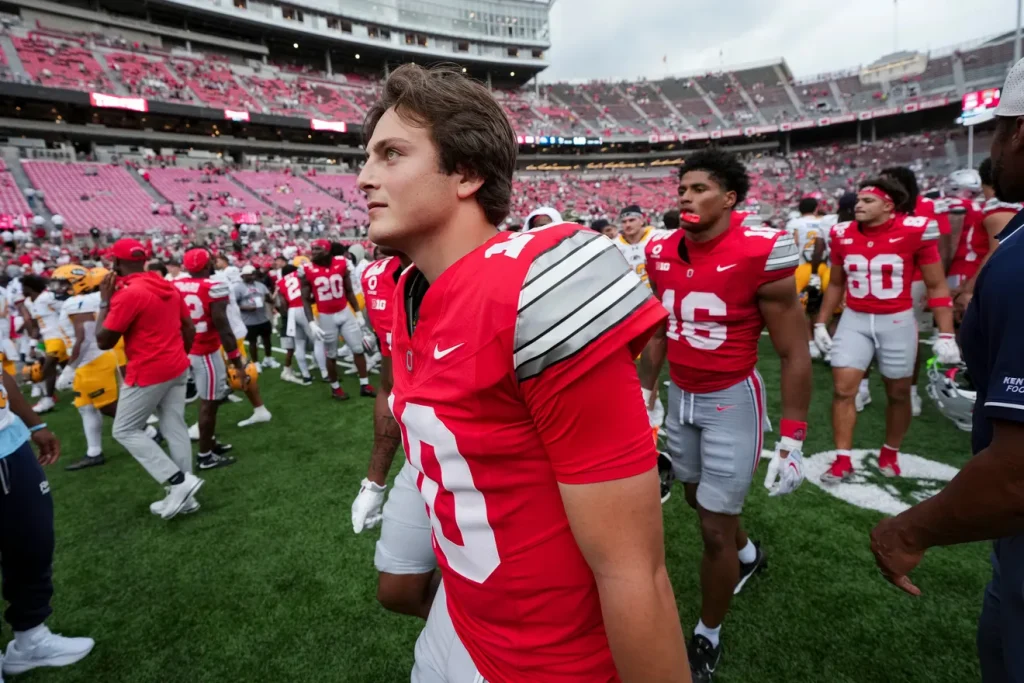
Ryan Day explains Ohio State’s third-down, red-zone, and short-yardage struggles, revealing offensive issues that extend beyond quarterback Julian Sayin.
Ohio State enters Big Ten play with questions at third down, in the red zone, and in short-yardage situations. The Buckeyes are 12-of-33 (36.4%) on third down and 12-of-17 (70.6% touchdown scoring rate) in the red zone through three games. The numbers point to an offensive issue beyond Julian Sayin’s rare decision-making blunders.
Sayin has areas to improve, particularly after his fourth-down sack against Kent State last Saturday. Ryan Day’s comments Tuesday also pointed to protection, timing, blocking, personnel, and scheme.
“I think we all want a higher level of consistency,” Day said.
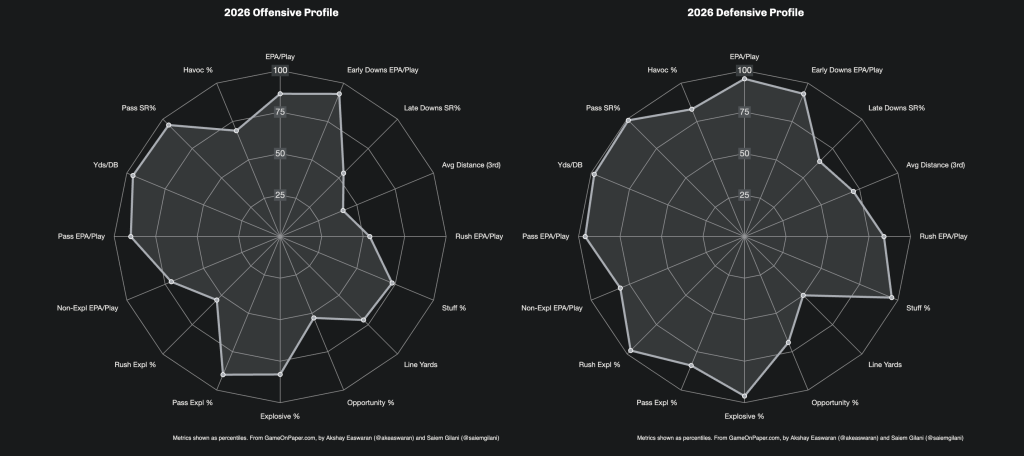
Efficiency has been an important emphasis for Day. Ohio State is one of the most efficient passing teams in the country. However, the Buckeyes have glaring weaknesses in average third-down distance, late-down success rate, and rushing efficiency per play.
Third Down and Red-Zone Production
Ohio State has converted 12 of 33 third-down attempts through three games, creating too many stalled drives. The Buckeyes have also failed to score a touchdown on five of 17 red-zone trips. The offense has only been turned away twice empty-handed, and has made three field goals.
Day said the offense must improve its play execution while the coaching staff examines other factors.
“It’s a combination of executing plays better but also looking at other things because I think it’s both of those,” Day said.
Those issues involve the entire offense. Ohio State’s offensive line has been inconsistent to start the year, but Gabe Van Sickle has the highest PFF grades (72.1 OVR; 88.2 PBLK; 72.6 RBLK) among the starters this year. Here are the rest of the starting offensive linemen’s grades:
Ian Moore: 70.0 (OVR); 75.3 (PBLK); 64.2 (RBLK)
Carson Hinzman: 69.0 (OVR); 81.8 (PBLK); 62.7 (RBLK)
Austin Siereveld: 68.6 (OVR); 53.3 (PBLK); 71.9 (RBLK)
Phillip Daniels: 65.7 (OVR); 79.3 (PBLK); 56.7 (RBLK)
Luke Montgomery: 62.7 (OVR); 66.2 (PBLK); 60.5 (RBLK)
The grades suggest Ohio State’s problem isn’t isolated to one offensive lineman. The Buckeyes have several players performing reasonably well in pass protection, while the run-blocking grades show more inconsistency across the unit.
Coach Day said there isn’t much separation between the combinations with Daniels and Van Sickle. He did not say one was better or worse, but alluded to them being comparable. Daniels’ status remains up in the air due to the Big Ten availability report protocols, but he practiced Tuesday. Still, the staff wants to nail down a consistent group heading into conference play.
Note: Austin Siereveld’s numbers reflect playing right guard and tackle combined. His time at right tackle is his third position in as many years.
Day said Ohio State had running lanes against Texas and Kent State that should have produced explosive plays. He pointed to missed opportunities at the second level, where blocking failed to create big plays. On the other side, Day said the running backs didn’t lower their shoulders or get shifty and lay a stiff arm to run through defenders.
Short-yardage plays have presented another issue. Day pointed to breakdowns in the C and D gaps and said the Buckeyes must address them. The offensive line, tight ends, and running backs all contribute to those situations, as a missed block or poor decision can determine whether Ohio State converts.
Julian Sayin Only Part of the Equation
Sayin’s fourth-down sack against Kent State was an individual mistake. Day said Sayin did not progress through the play effectively and needed to trust his feet. He also believed the quarterback had an opportunity to escape and extend the play. Sayin acknowledged the mistake after the game.
“We’ve got to trust our feet,” Day said. “We’ve got to get the ball out on time.”
Sayin must improve his progression reads, pocket movement, and timing. Day has also said the offense has received solid protection overall, placing more focus on the quarterback’s decisions and playmaking in key situations. Sayin’s pocket decisions have contributed to stalled possessions, but the offense has also struggled to create favorable situations for him on third down and in short yardage.
Ryan Day Also Examines the Coaching
Day said the coaching staff must determine whether the problems stem from player performance, coaching, or scheme. That review could lead to personnel or schematic changes, which appear to be taking place. Ohio State’s run distribution suggests Smith is adjusting the ground game. The Buckeyes went heavily toward zone concepts in Week 1 before moving closer to an even zone-gap split against Kent State.
“We have to justify our coaching,” Day said. “And if we’re not getting it, we gotta figure out ways to get it done.”
Ohio State Zone/Gap
week 1: 26-2
Week 2: 15-11
Week 3: 17-19
Arthur Smith is a wide zone guy and he’s adjusting to what his players do better rather than forcing it. That’s the good.The not so good against Kent,
Just 4 rushes of 10+ with a long or 17. 6 missed tackles…— Juck Miletti (@JuckOnBucks) September 20, 2026
According to Juck Miletti’s charting, Ohio State produced only four runs of at least 10 yards against Kent State, with a long of 17 yards. Explosive plays in the run game have been scarce and need to start happening out of the backfield.
Arthur Smith is identifying which personnel combinations work best in short-yardage situations and which concepts create reliable opportunities on third down and near the goal line.
The Buckeyes have been losing the numbers game in short yardage because the running backs aren’t making guys miss, and Sayin hasn’t exercised his legs to improve conversion rates. That gives the defense an extra defender the offense can’t block or account for, which is a symptom of the Buckeyes’ problem.
Ohio State’s third-down, red-zone, and short-yardage performance will provide evidence of whether the Buckeyes have addressed the issues. Illinois will be the first opportunity to see whether those adjustments translate against Big Ten competition.
NEXT: Read Ryan Day Challenges Ohio State Running Backs to “Run Angry” as Run Game Seeks Consistency

Blake Biscardi serves as Co-Founder, Lead Reporter, and Senior Editor of The Silver Bulletin. He hosts the Buckeye Cadence podcast, where he breaks down Ohio State football and basketball with an inside look into the programs. Covering Julian Sayin in New York City in 2025 was his Heisman moment, which became a viral moment in its own right. Biscardi is a member of the Football Writers Association of America (FWAA) and has degrees in Business Administration and Strategic Communication & Leadership.
Discover more from The Silver Bulletin
Subscribe to get the latest posts sent to your email.