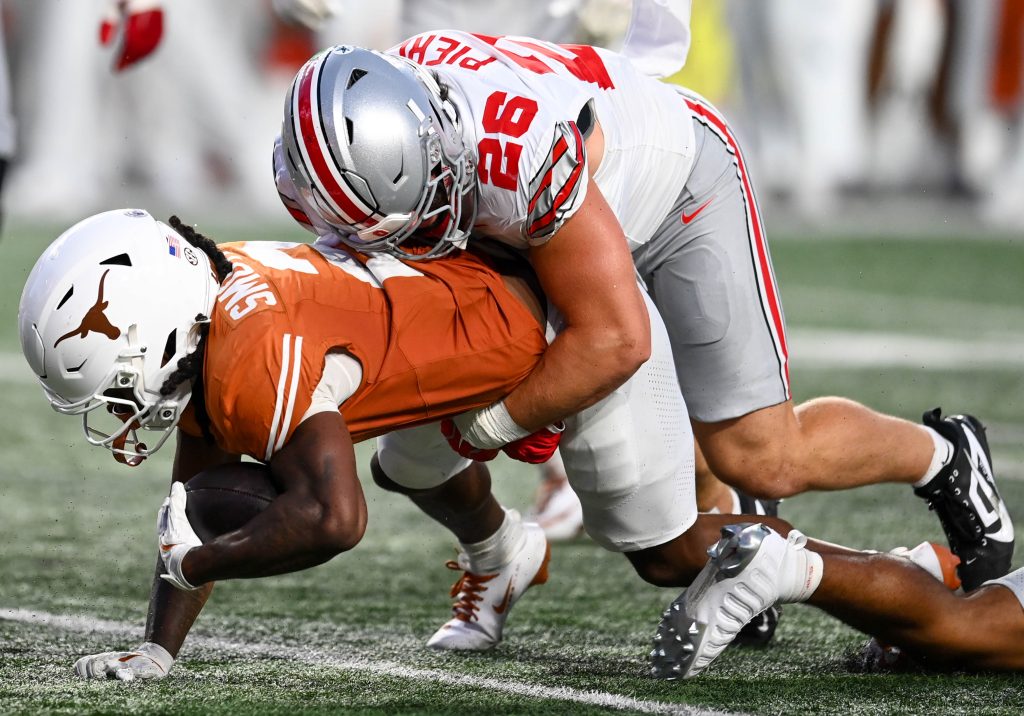
Ohio State led Texas by 20 points but failed to execute late, allowing the Longhorns to complete a stunning fourth-quarter comeback.
Ohio State never had to lose to Texas. The Buckeyes led 20-3 at halftime, extended the advantage to 23-3 in the third quarter, and had every opportunity to put the Longhorns away. Instead, missed opportunities and poor execution across all three phases let Texas turn a game Ohio State controlled into a 24-23 comeback win.
Ohio State’s loss was not created by one decision, one player, or one fourth-quarter possession. Ryan Day pointed to execution across all three phases when he met with reporters Tuesday, and his assessment matched what unfolded on the field. The Buckeyes missed opportunities on offense, defense, and special teams, allowing Texas to stay within striking distance long enough to make the fourth quarter matter.
The fourth quarter never had to matter. Until it did.
Did Ohio State Start Thinking About the Fourth Quarter Too Early?
Day said Ohio State talked at halftime about the game being a four-quarter battle. That statement is understandable against Texas, particularly in a matchup featuring two teams with national championship aspirations. But it also raises a question about the mindset entering the second half.
Ohio State led 20-3 and received the opening kickoff of the third quarter. The Buckeyes had a chance to take control and make Texas chase the scoreboard for the rest of the night. Could Ohio State have approached the second half expecting to keep extending the lead and empty the stadium?
No evidence shows the Buckeyes consciously shifted their mindset because of that halftime message. The result, however, makes the question worth asking.
Day’s own definition of winning the fourth quarter goes beyond making a final defensive stop or producing a game-winning drive. He said the Buckeyes had discussed that before the season, explaining that winning the fourth quarter also means finishing games when holding a 20-3 or 23-3 lead.
Ohio State did not need a dramatic fourth quarter to beat Texas. It needed to play well enough earlier to prevent one from developing.
Ohio State Had Multiple Chances to Put Texas Away
The Buckeyes had opportunities immediately after halftime. Ohio State’s first second-half drive stalled at the Texas 40-yard line. Later, after a 43-yard completion to Jeremiah Smith, the Buckeyes settled for a field goal to make it 23-3. The offense had opportunities to create separation but failed to capitalize.
Day also discussed a fourth-and-four decision in which Ohio State elected to punt and try to pin Texas deep. The strategy itself was not the only issue. Day acknowledged that the pooch punt was poorly executed.
Ohio State was not searching for one perfect play to win the game. The Buckeyes needed routine execution to stack positive possessions and force Texas into an increasingly difficult situation.
The offense also had breakdowns inside the red zone. Day pointed to negative plays that reduced Ohio State’s chances of scoring touchdowns, including a nine-yard loss he described as a complete disaster. A sack followed, putting the Buckeyes in another difficult situation.
Later, Ohio State missed a 45-yard field goal after reaching scoring range. None of those plays decided the game on its own. Collectively, they kept Texas alive.
The Fourth Quarter Was a Consequence, Not the Beginning of the Problem
Texas’ fourth-quarter comeback became the game’s defining image, but the problems began well before the final 15 minutes.
The Longhorns scored 21 unanswered points in the fourth quarter, while Ohio State struggled to sustain its offense and generate enough resistance defensively. Texas converted four of five third downs in the final quarter and held the ball for more than 10 minutes. Ohio State’s defense eventually had to defend a series of long possessions, totaling 40 plays.
Day acknowledged that the Buckeyes did not play well in the fourth quarter, but he also repeatedly emphasized that the entire team had ownership in the loss.
It starts with execution. Ohio State’s offense needed to sustain drives. The defense needed to get off the field. Special teams needed to execute punts and field-position opportunities. Coaches needed to put players in better situations, and players needed to make the plays when those situations arrived.
The Buckeyes didn’t get enough of that combination while the game was still in their control.
Winning the Fourth Quarter Can Mean Making It Boring
People tend to define winning the fourth quarter as making a late stop, converting a third down with the game on the line, or putting together a final scoring drive. But Day offered a broader definition.
“When it comes to winning the fourth quarter, winning the fourth quarter isn’t just winning at the end of the game, which didn’t happen. It’s also when you’re up 20-3 or 23-3. You finish the game and you empty out the stadium, but that didn’t happen,” Day said.
If Ohio State leads 20-3 at halftime and 23-3 in the third quarter, winning the fourth quarter can mean extending the advantage until Texas has no realistic path back into the game. It can mean continuing to execute, sustaining offensive pressure, and forcing the opponent to spend the final period playing catch-up without enough time or possessions to change the outcome.
In that scenario, the fourth quarter becomes almost an afterthought. Ohio State had the opportunity to create that kind of game. It did not. Instead, the Buckeyes let Texas stay within range, and every earlier missed opportunity became more important as the clock moved toward the final quarter.
Ohio State Has to Turn Execution Into Its Identity
Day said Tuesday that the loss gave Ohio State information it can use moving forward. He also made clear that the program cannot keep repeating the same mistakes and expect a different result, and that everyone is responsible.
The coaching staff has to evaluate its decisions and determine where it can put players in better positions. Players have to execute at a higher level. The team has to identify which personnel can consistently make plays in critical moments. Day said younger players will have more opportunities as the Buckeyes enter conference competition, and the staff will keep evaluating how those pieces fit together.
Day pointed to the second-half execution as a team issue. Ohio State attempted 12 passes and 10 runs after halftime, which he said showed the Buckeyes were still trying to score. The problem, he said, was execution.
“Because if we hit those throws or we execute on those runs, we’re not in this situation. That’s the bottom line, and so we’ve got to get that fixed.”
Ohio State had Texas exactly where it wanted the Longhorns. The Buckeyes led 20-3 at halftime and 23-3 in the third quarter. The fourth quarter did not need to become a test of survival.
It became one because Ohio State left too many opportunities on the field. The Buckeyes need to learn that they have to finish like the team that built a 20-point lead in the first place. The fourth quarter never had to matter. Ohio State had plenty of chances to make it happen.
NEXT: Read Ohio State’s Identity Has Changed: Ryan Day Must Trust Jeremiah Smith and Julian Sayin

Blake Biscardi serves as Co-Founder, Lead Reporter, and Senior Editor of The Silver Bulletin. He hosts the Buckeye Cadence podcast, where he breaks down Ohio State football and basketball with an inside look into the programs. Covering Julian Sayin in New York City in 2025 was his Heisman moment, which became a viral moment in its own right. Biscardi is a member of the Football Writers Association of America (FWAA) and has degrees in Business Administration and Strategic Communication & Leadership.
Discover more from The Silver Bulletin
Subscribe to get the latest posts sent to your email.