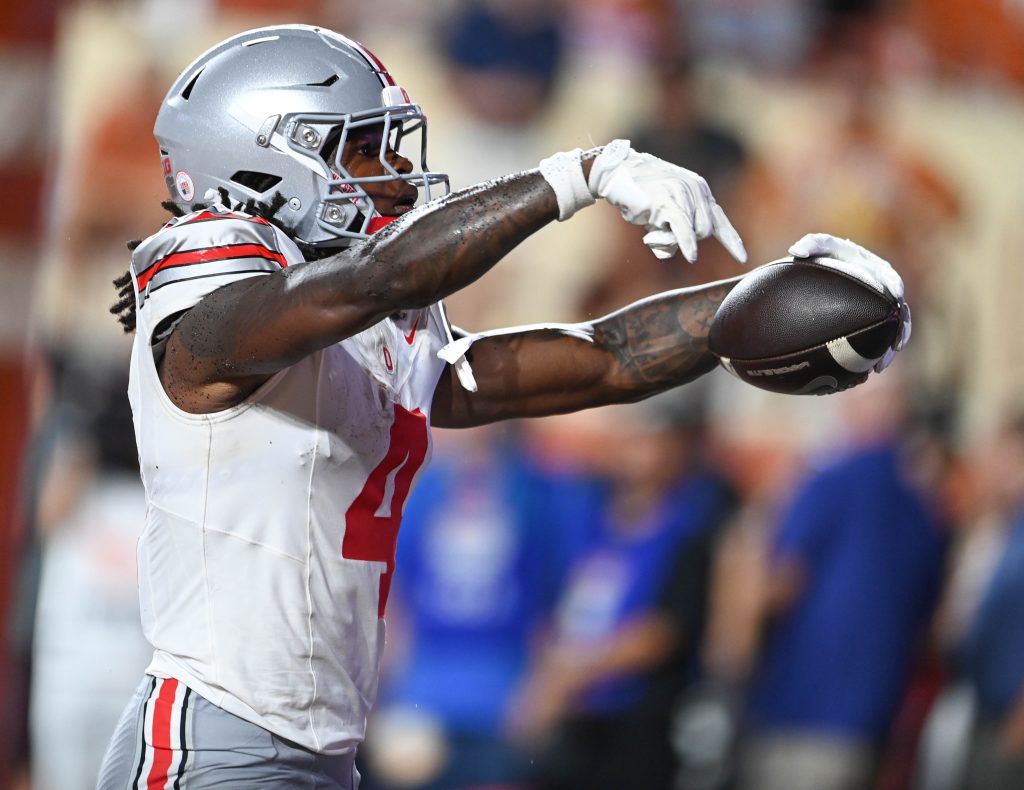
Ohio State must embrace its offensive identity and trust Jeremiah Smith and Julian Sayin when the game is on the line.
Ohio State’s best player was standing on the sideline when the game was hanging in the balance. Jeremiah Smith had eight catches for 164 yards and a touchdown against Texas, and he was the most dangerous player on the field for most of the night. He watched the final minutes from the sideline while Ohio State relied on its defense to get one more stop. Texas scored, and the Buckeyes got the ball back with roughly 25 seconds remaining.
The final defensive possession will draw plenty of attention, but the decision before it deserves just as much consideration. Ohio State had an opportunity to put the game in the hands of Julian Sayin and an offense led by Smith. Instead, the Buckeyes asked their defense to close out the game.
A year ago, I understood that decision. Kayden McDonald was in the middle of the defense, and Caleb Downs was playing behind him. Ohio State had experienced players across the front seven who had already shown they could win critical snaps at the goal line. Those players had earned the trust to be on the field when a game needs one final stop.
This year’s defense has not reached that point yet. Matt Patricia has talented players to work with, and the group has plenty of time to improve. Ohio State may feel differently about this defense by November. In Austin, however, the Buckeyes were asking a group that had spent much of the second half on the field to make another play in the Texas heat.
Texas possessed the ball for 10:07 and accumulated 236 yards and three touchdowns in the final quarter. The Longhorns also converted 4 of 5 third downs.
Ohio State was searching for fresh bodies, and Epi Sitanilei saw snaps during the critical possession because the Buckeyes needed another player up front. Texas had found its rhythm, and the defense was handling the conditions and workload that had built up throughout the second half.
The Buckeyes’ identity has changed from last season. Ohio State is an offense-driven team with a quarterback who operates the offense at a high level and a receiver who is the best player in the sport. When the game reaches its most important possession, those are the players who should be on the field.
Smith’s value goes beyond his production. His presence changes how defenses have to play Ohio State. Texas could have given him additional safety help and created opportunities for another receiver. Or the Longhorns could leave him in single coverage and give Sayin the matchup he wants.
A defender could also shade toward Smith and create space somewhere else on the field. Brandon Inniss, Devin McCuin, and Chris Henry Jr. can all benefit from the attention Smith’s gravity reels in, giving Ohio State multiple ways to attack the defense.
Smith does not need to catch the winning pass to influence the outcome. His presence can create the winning play for somebody else, which makes keeping him off the field late in a close game difficult to justify. If Ohio State needs a score, I want its best player on the field because he gives the offense another way to create an advantage on every play.
The clock became a major problem against Texas. Ohio State eventually got the ball back with roughly 25 seconds remaining, leaving Sayin with almost no room to operate. A sack could end the game, or an incompletion could force Ohio State into a desperate situation. Just as much, a long-developing play could take away the remaining opportunity. The offense needed time to have a reasonable chance to answer, and the coaches did not give it that time.
They could have put their offense back on the field earlier and allowed Sayin more time to work. Texas was already moving the football, and Ohio State’s defense had spent much of the fourth quarter trying to slow the Longhorns down. Texas could have scored at any moment, so Ohio State needed to consider what it wanted its offense to inherit if the Longhorns reached the end zone. Giving Sayin a minute or more would have created a completely different situation from handing him the ball with 25 seconds.
There was no certainty that Sayin would lead a touchdown drive, nor that Ohio State would even reach field-goal range. The offense deserved the opportunity to try with enough time on the clock. Sayin and Smith were making plays, and Texas had to account for Smith in coverage on every possession.
The Buckeyes should have put the game in the hands of their best offensive players. However, the final defensive possession did not give them that opportunity. Ryan Day said the staff decided to play defense on second down, and then evaluate the situation. They decided to let the defense make a stop. Ultimately, they fell short, and the Longhorns scored.
Ohio State had its best player standing on the sideline and its quarterback waiting for a chance to lead a meaningful final drive. But the offense never got enough time to find out whether it could win.
The defense may develop into a unit capable of winning those situations. Patricia has the rest of the season to build that trust, and Ohio State will need defensive stops against good teams. There will be games when the defense has to make the play that decides the outcome. Against Texas, the Buckeyes had another option that better matched this team’s personnel and identity.
Ohio State can put Sayin and Smith on the field and give the offense enough time to operate. Sayin can make the decisions, Smith can force the defense to account for him, and the rest of Ohio State’s playmakers can take advantage of the opportunities created around them.
Ryan Day has to trust his team’s strengths and identity when the game is on the line. Against Texas, Ohio State chose to put the outcome on its defense and left its best offensive player watching from the sideline.
NEXT: Read Ohio State Collapses Against Texas: Did Ryan Day Play Not to Lose?

Blake Biscardi serves as Co-Founder, Lead Reporter, and Senior Editor of The Silver Bulletin. He hosts the Buckeye Cadence podcast, where he breaks down Ohio State football and basketball with an inside look into the programs. Covering Julian Sayin in New York City in 2025 was his Heisman moment, which became a viral moment in its own right. Biscardi is a member of the Football Writers Association of America (FWAA) and has degrees in Business Administration and Strategic Communication & Leadership.