After four straight wins, including a road victory at Iowa, can Ohio State be trusted against Indiana and the toughest remaining schedule in college football?
Which version of Ohio State better represents the team: the one that dominated the first three quarters against Texas or the one that surrendered a 20-point lead in the fourth?
Ryan Day frequently talks about trust when discussing playing time for transfers and young players. As Ohio State enters the toughest stretch of its schedule, the question goes beyond individual roles: Can the Buckeyes be trusted to win the games that will determine their season?
ESPN’s Game Control metric ranks Ohio State No. 1 nationally. The Buckeyes are 5-1, with their only loss coming against Texas. ESPN also ranks their remaining schedule as the toughest in college football, beginning with Saturday’s road trip to Indiana.
The loss in Austin exposed Ohio State’s inability to finish a game it controlled. Since then, the Buckeyes have won four straight, including a 31-14 road victory over No. 14 Iowa. Their performance in Iowa City is the strongest evidence yet that this team has developed since September.
Iowa Showed What Ohio State Can Be
Beating a ranked Iowa team at Kinnick Stadium is a meaningful result for any program. Ohio State controlled the matchup, outgaining the Hawkeyes 484-238 and holding them to 28 yards of offense in the third quarter as the Buckeyes extended their lead.
The defense set the tone early. Kenyatta Jackson Jr. forced a strip-sack that Christian Alliegro recovered, giving Ohio State possession deep in Iowa territory. Two plays later, Julian Sayin connected with Devin McCuin for a touchdown.
Ohio State continued to build its lead through the middle quarters, then answered Iowa’s attempt to rally with a touchdown run from Ja’Kobi Jackson. When the Hawkeyes scored in the fourth quarter to cut the margin to 17 points, the Buckeyes possessed the ball for the remainder of the game.
Ohio State didn’t need another explosive play or a late defensive stand because it controlled possession and removed Iowa’s chance to mount a comeback. Day recognized the value of the win afterward.
“Collectively, to go on the road and win a game like that matters,” Day said on his radio show.
The result also showed progress from players who have earned larger roles. Ja’Kobi Jackson made his first start as a Buckeye and rushed 14 times for 72 yards and a touchdown, while he and Bo Jackson combined for 142 yards on 30 carries. Ohio State ran the ball 28 times on 39 plays in the second half.
Day praised the physicality of the running backs but maintained that the offense could create more explosive runs. “I think they ran downhill and they got physical,” Day said. “I think our running game right now, when you look at the efficiency, is solid, but we want to be more explosive still. We want to create bigger runs.”
The Offense Has More Ways to Win
Ohio State’s offensive development extends beyond the running game. Sayin has become more willing to use his legs, adding another option as defenses take away the initial passing concepts. Against Illinois, he rushed seven times for 29 yards and a touchdown.
His mobility complements the threat of Jeremiah Smith, whose presence continues to dictate how defenses approach Ohio State. When opponents commit additional coverage to Smith, the Buckeyes need their other receivers to capitalize.
They have begun to do that, and the supporting cast doesn’t need to replicate Smith’s production. Brock Boyd and Chris Henry Jr. have earned opportunities, while tight end Nate Roberts caught a 68-yard touchdown against Maryland.
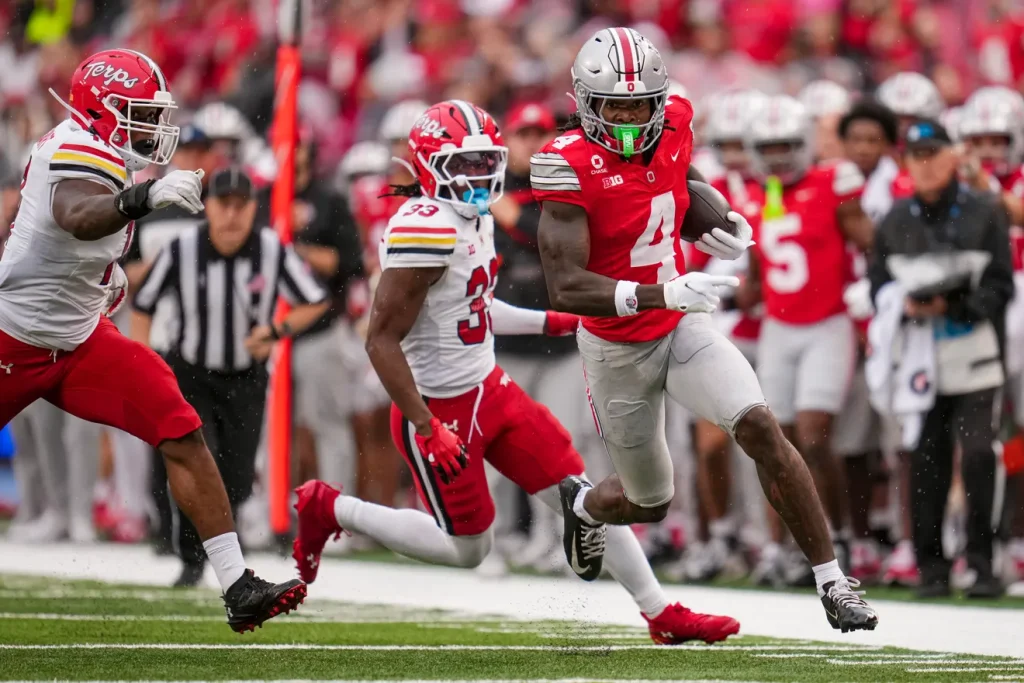
Ohio State followed its Iowa win with a 45-16 victory over Maryland, rushing for 207 yards. Bo Jackson recorded 107 yards and two touchdowns, while Ja’Kobi Jackson added 76 yards. Roberts’ long touchdown also demonstrated the offense’s ability to generate explosive plays through players beyond its leading receiver.
The fourth quarter against Texas exposed the offense’s inability to maintain drives under pressure. Ohio State’s improved running game and greater versatility give Sayin more answers, but those options must translate into points when the game is on the line.
Discipline Remains a Concern
“Nobody just gets on the field because they have talent,” Day said last week.
Ohio State’s defense has limited opposing offenses in its last two games. Iowa finished with 238 total yards, while Maryland quarterback Malik Washington managed just 64 passing yards.
The Buckeyes still have mistakes to eliminate. Maryland scored on a pick-six, and Ohio State committed eight penalties for 65 yards. Day criticized both issues after the game, calling the penalty total “not the sign of a good team” and saying the turnovers “can’t happen.”
Day also accepted responsibility for the team’s mistakes, saying, “It’s a direct reflection of coaching…It starts with me.”
Ryan Day takes full accountability for the team’s costly penalties and turnovers, making it clear the standard starts at the top:
“It’s a direct reflection of coaching…It starts with me.” https://t.co/c3urdC9KIC
— The Silver Bulletin (@tSilverBulletin) October 11, 2026
His accountability sets the standard, but the players must meet it on the field. A turnover that gives an opponent a defensive touchdown, or a penalty that extends a drive, can change a game against a team that can capitalize on those opportunities.
Indiana, USC and Oregon will challenge Ohio State in different ways. The Buckeyes must communicate effectively, tackle consistently, and avoid the costly penalties that give opponents extra possessions or favorable field position. Their recent defensive performances are a foundation, but better competition will test their discipline.
Indiana Is the Next Test
Indiana is Ohio State’s first road matchup against a top-five opponent since the loss in Austin. The undefeated Hoosiers open a stretch that also includes USC, Oregon, Northwestern, Nebraska, and Michigan.
Ohio State needs its running game to keep the offense ahead of the chains, Sayin to recognize when to extend plays, and the supporting receivers to punish defenses that focus extra attention on Smith. Defensively, the Buckeyes must limit explosive plays and force Indiana to earn its points over sustained drives.
The larger challenge is finishing. Day addressed that failure after the Texas loss, explaining that winning the fourth quarter starts long before the final minutes.
“When it comes to winning the fourth quarter, winning the fourth quarter isn’t just winning at the end of the game, which didn’t happen,” Day said after the Texas loss. “It’s also when you’re up 20-3 or 23-3. You finish the game and you empty out the stadium, but that didn’t happen.”
Ohio State did a better job protecting its advantage against Iowa, using its running game and controlling the ball when the Hawkeyes tried to rally. The Buckeyes followed with another decisive win over Maryland, though the pick-six and penalties showed execution remains a work in progress.
Ohio State Must Prove It Against the Best
ESPN’s No. 1 Game Control ranking reflects Ohio State’s performance to date, but the schedule ahead will better measure its championship potential. The Texas loss still looms as a reminder of what can happen when the Buckeyes fail to execute under pressure.
Four straight wins have given Ohio State reason to be confident. The running game has become a more reliable part of the offense, Sayin has added a dimension with his legs, and the defense has helped control the last two opponents. The Maryland victory extended that momentum, but the mistakes against the Terrapins cannot become a pattern.
Based on how the Buckeyes are trending, they are worth trusting in Bloomington and for the rest of the regular season and beyond.

Blake Biscardi serves as Co-Founder, Lead Reporter, and Senior Editor of The Silver Bulletin. He hosts the Buckeye Cadence podcast, where he breaks down Ohio State football and basketball with an inside look into the programs. Covering Julian Sayin in New York City in 2025 was his Heisman moment, which became a viral moment in its own right. Biscardi is a member of the Football Writers Association of America (FWAA) and has degrees in Business Administration and Strategic Communication & Leadership.
Discover more from The Silver Bulletin
Subscribe to get the latest posts sent to your email.