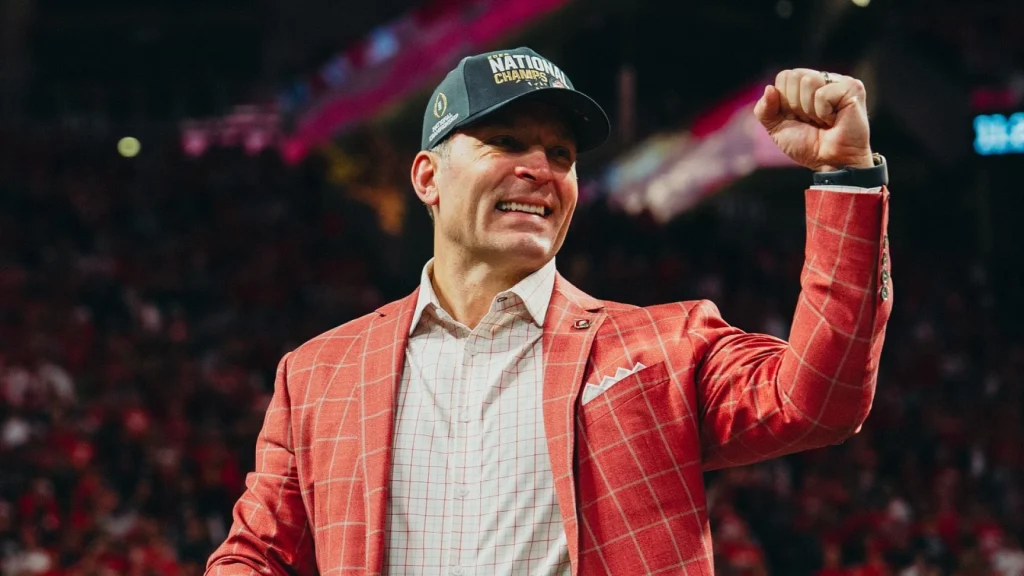
Ross Bjork spoke to The Silver Bulletin on the Big Ten’s involvement in shaping college football and how Ohio State is using its voice to lead.
The most powerful conference in college athletics is sitting on $1.37 billion in annual revenue and three consecutive national championships. The landscape is shifting faster than it ever has, and the Big Ten Conference is at the center of every conversation. Revenue sharing, NIL legislation, playoff expansion, conference realignment, and media rights pooling are heading the future outlook.
Ohio State Athletic Director Ross Bjork believes the Big Ten has an obligation to lead from its seat at that table.
“We should be at the forefront of all these conversations,” Bjork told The Silver Bulletin. “We provide the most resources to student athletes. We carry the most amount of sports, and we’ve obviously been highly competitive. You’ve got to use that in the right way.”
The Big Ten distributed $1.37 billion to its 18 member institutions for the fiscal year ending June 30, 2025 — the largest distribution in conference history, representing a $490 million increase from the prior year. With an average payout of $76.1 million per school, Big Ten members now out-earn even the SEC’s average per-team distribution of $72.4 million.
Protecting the Enterprise
For Bjork, using it the right way is the operative phrase. In any high-stakes environment, making noise, pounding the table, and letting volume drive the strategy is tempting, but he is not interested in that. Instead, perspective and precision are at the forefront of his mind because these changes need to be done right.
“It’s easy to pound on the table,” Bjork said. “But to me, it’s like, no, this is what the perspective is. We think this is good for not only the Big Ten, but for the enterprise.”
His choice of the word “enterprise” is a key factor that isn’t always a focal point in discussions about the future of college football. Bjork is not only thinking about what benefits Ohio State or even the Big Ten in isolation. He is concerned about the structural health of college athletics as a whole, and he believes the Big Ten’s influence is best deployed when using a broader structure rather than in narrow self-interest.
As Ohio State’s athletic director, Bjork said the expectation to lead is built into the job description, whether you ask for it or not.
“Ohio State, I think what I’ve learned is that you’re just expected to be a leader,” he said. “You’re expected to have an opinion, so you better study the issues. You better know the issues, you better articulate it the right way.”
That culture of preparation is supported from the top of the conference down. Bjork was pointed in his praise of Big Ten Commissioner Tony Petitti, crediting him with building an environment where athletic directors are never left guessing about where things stand.
“Commissioner Petitti — he is so good at communicating with all of us, almost on a daily basis,” Bjork said. “So we never feel like we don’t have all the information, and I think that’s a healthy environment.”
That kind of communication infrastructure means more than it might seem from the outside. When the issues on the table are as complex and fast-moving as the ones college athletics is currently navigating, the difference between a conference that acts with clarity and one that reacts often comes down to whether the people making decisions feel informed, aligned, and trusted. Petitti, by Bjork’s account, has built that.
Can the Big Ten Lead College Athletics?
The Big Ten is a coalition of institutions with different histories, resources, competitive ambitions, and, increasingly, financial realities. Holding that collection together while also steering it through the most disruptive era in the history of college sports is a difficult task. Bjork acknowledges that, but also believes the conference has found a rhythm — and that Ohio State, as one of its most visible and resourced members, has a responsibility to help maintain it.
“I think I found my rhythm in that,” Bjork said. “Sometimes, maybe we talk too much. Maybe we just need to let things play out. But I think it’s a good rhythm that we have.”
The decisions ahead are not small ones. Playoff structure, revenue distribution, potential capital investments, scheduling partnerships, and more will form college athletics for the next two decades. Ross Bjork is navigating that reality every day from inside one of the most influential athletic departments in the country.
The Big Ten has the resources and leverage to influence the future of college athletics. Whether it uses that position to serve the enterprise — or to expand its own footprint at everyone else’s expense — is the governing question of this era. Bjork’s answer is studied and measured on the belief that the enterprise is worth protecting. The Big Ten has spent the last three years proving it can win. But the next three years will reveal whether it knows how to lead.
NEXT: Read BOOM! Five-Star Wide Receiver Jett Harrison Commits to Buckeyes

Blake Biscardi serves as Co-Founder, Lead Reporter, and Senior Editor of The Silver Bulletin. He hosts the Buckeye Cadence podcast, where he breaks down Ohio State football and basketball with an inside look into the programs. Covering Julian Sayin in New York City in 2025 was his Heisman moment, which became a viral moment in its own right. Biscardi is a member of the Football Writers Association of America (FWAA) and has degrees in Business Administration and Strategic Communication & Leadership.