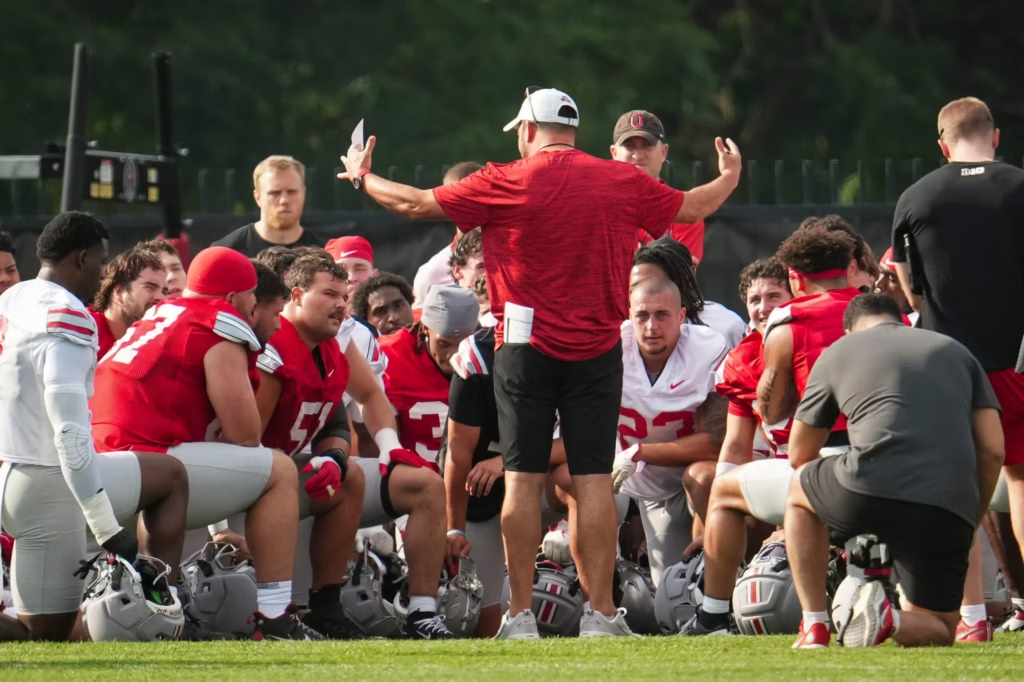
Adam Cairns/Columbus Dispatch / USA TODAY NETWORK via Imagn Images
College football has changed dramatically. Ohio State’s answer has been to change with it without losing what made the program successful in the first place.
COLUMBUS, Ohio — Ryan Day was in a meeting when someone told him LSU had added a player directly from an NFL roster. A Cleveland Browns tight end was headed back to college football, another sign of how much the sport has changed.
The transfer portal can reshape a roster in weeks. NIL has transformed the way programs recruit and retain players. Eligibility rules continue to evolve, and coaches are now managing increasingly professionalized personnel operations. Even a player moving from an NFL roster back into college football is no longer outside the realm of possibility.
“We are certainly in a different world right now,” Day said.
He has been just as candid about the uncertainty surrounding roster construction. “To think that we’re in a situation where we’re this late in the season, and our rosters are not locked in is frustrating at the very least,” Day said. “Do I like anything about it? Absolutely not, but we got to do what’s right for Ohio State.”
The rules are changing, too. The Big Ten is set to pass a rule Tuesday preventing players who have declared for the NFL Draft and did not withdraw, appeared on an NFL roster, or signed a professional contract from returning to a Big Ten roster, according to ESPN’s Pete Thamel.
It’s another example of how quickly the ground can shift in college football. Ohio State can’t control those changes. What it can control is how the program responds to them.
There are plenty of circumstances in the current landscape that a coach could point to when things go wrong. Day has acknowledged those changes without allowing them to become excuses. Ohio State cannot control where college football is headed. It can control how it operates within it.
“There’s no blaming, complaining or defending in this program.”
The phrase has become part of Ryan Day’s vocabulary, but the philosophy behind it predates him. E+R=O — Event + Response = Outcome — and BCD, which stands for Blame, Complain, and Defend, trace back to Tim and Brian Kight. The principles were implemented at Ohio State under Urban Meyer in 2013 and have continued under Day.
The circumstances surrounding the program have changed considerably since then, but the principle has not. Ohio State cannot control how the transfer portal operates, when eligibility rules change, or what another program does to improve its roster. It can control how it prepares its players, develops its leaders, and responds when circumstances change.
“Either you adapt, or you die,” Day said this spring while discussing the rapidly changing landscape and constant roster turnover. “So we’re going to adapt. We’re not going to die.”
That approach has shaped how Ohio State has evolved with the sport. The program has expanded its infrastructure, modernized its personnel operation, and continued to invest in recruiting and NIL. Day has added former NFL head coaches Arthur Smith and Matt Patricia to his staff as he continues to build an organization that reflects elements of the professional game.
The operation has changed, but the standard has not. College football no longer allows programs to rely on continuity in the same way they once did. NFL departures create annual turnover, while the transfer portal can reshape entire position groups in an offseason. Coaches must manage their own roster while continuing to recruit high school players and navigate an increasingly complicated NIL environment.
Ohio State enters the 2026 season with 51 new players. At the same time, the program has named seven returning players as captains: Julian Sayin, Jeremiah Smith, Brandon Inniss, Austin Siereveld, Payton Pierce, Kenyatta Jackson and Jaylen McClain.
The seven captains represent six of Ohio State’s nine major position groups. They also provide something that cannot be added through a recruiting class or a transfer portal: familiarity with the program.
Sayin enters his second season as Ohio State’s starting quarterback. Siereveld returns along the offensive line, while Smith and Inniss provide experience at receiver. Pierce, Jackson and McClain give the defense returning leadership at all three levels.
That group knows what it means to play at Ohio State. They have experienced the pressure, the scrutiny, and the consequences that come with falling short. They have also experienced what it takes to prepare for a season, play in front of a packed Ohio Stadium crowd, and travel to difficult road environments.
When Day discussed Sayin’s second season, he described the difference between experience and inexperience in simple terms.
“You’re remembering, not learning.”
A veteran player has a reference point. He has already lived through the moments a younger player is encountering for the first time. That experience becomes part of the way a program passes its expectations from one group to the next.
The 51 new players will learn Ohio State from coaches, but they will also learn it from the players around them. Returning players provide examples of how the program prepares, responds to adversity, and handles the expectations of playing at Ohio State.
Those elements are important because culture cannot depend entirely on the people who established it. If it is going to survive roster turnover, it has to be understood and embraced by the people in the building.
Day’s philosophy starts with relationships, which helps explain how Ohio State has adapted without constantly having to rebuild its identity. The program has invested in facilities, recruiting, NIL, personnel, and coaching. It has added NFL experience and changed the way it manages its roster.
Those resources are valuable, but they do not establish the culture on their own. Facilities do not create accountability. NIL does not create leadership. Hiring NFL coaches does not automatically create continuity. The people inside the organization determine how those resources are used.
At Ohio State, that structure extends beyond the head coach. Day provides the direction, and his staff provides the coaching and personnel structure. Veteran players carry those expectations into the locker room, while the captains reinforce them.
Leadership matters even more with 51 new players entering the program. Ohio State has gone through coaching changes, annual NFL departures, and a transformation in the economics and structure of college football. The operation has evolved through each transition without requiring the culture to start over.
Other programs are building similar personnel operations and investing heavily in the same areas. Ohio State’s distinction lies in the culture it has built around it.
The transfer portal will continue to move players, NIL will continue to influence roster decisions, and rules will continue to change. Ohio State will have to respond to all of it.
E+R=O provides the framework for doing so. The program cannot always control the event, but it can control its response, which will influence the outcome.
There is no guarantee that this approach produces a championship every season. Ohio State still has to recruit, develop, coach, and perform better than its opponents. But the program has spent more than a decade building a structure to withstand changes beyond the field.
The roster will change, and so will the rules. Ohio State has changed with them without losing the principles that made the program successful in the first place.
Ohio State cannot control what college football becomes next. It can control whether it is ready to lead it.
Join Us for TSB LIVE at DICK’s House of Sport’s Tailgate Takeover

Join us at DICK’s House of Sport in Polaris, OH, on Saturday, August 29, from 12-3 pm for a Tailgate Takeover to kick off football season! TSB LIVE returns for an on-site show with special guests previewing Ohio State’s 2026 season. You do not want to miss this event! Register here
NEXT: Read Leadership Could Be Ohio State’s Secret Weapon in 2026

Blake Biscardi serves as Co-Founder, Lead Reporter, and Senior Editor of The Silver Bulletin. He hosts the Buckeye Cadence podcast, where he breaks down Ohio State football and basketball with an inside look into the programs. Covering Julian Sayin in New York City in 2025 was his Heisman moment, which became a viral moment in its own right. Biscardi is a member of the Football Writers Association of America (FWAA) and has degrees in Business Administration and Strategic Communication & Leadership.
Discover more from The Silver Bulletin
Subscribe to get the latest posts sent to your email.