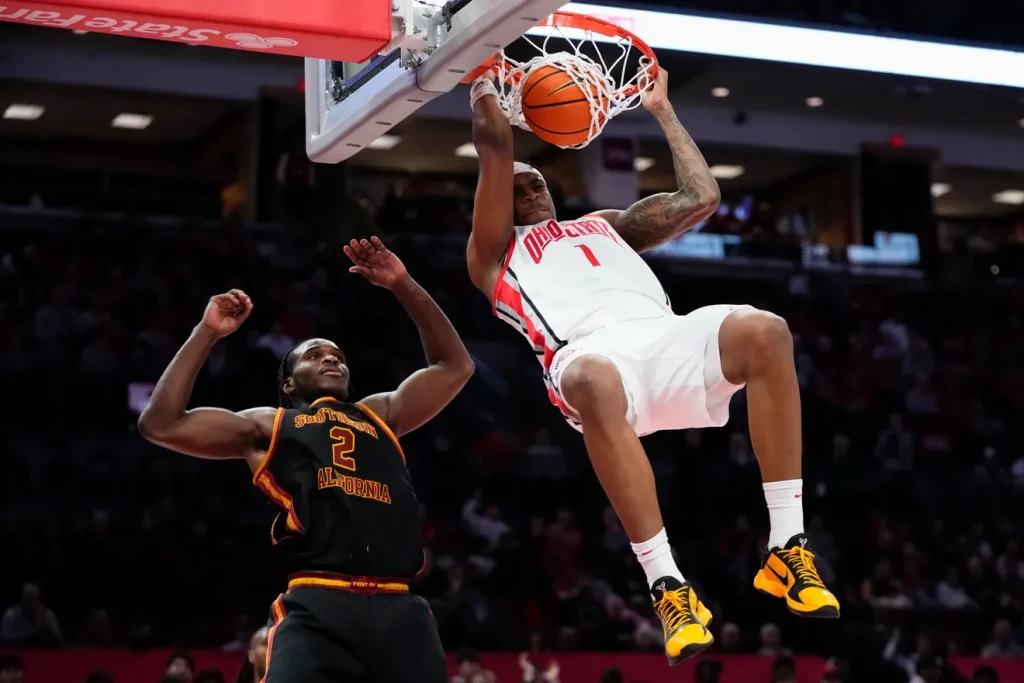
Ohio State’s response against USC may have revealed what Jake Diebler’s team can become heading into March as his team eyes Virginia.
February does not reward teams that drift. March is on the horizon across the College Basketball world. For Ohio State, Wednesday night’s 89-82 victory over USC was less about movement in the standings and more about answering a question that surfaced after the loss to Michigan: Who are we when challenged?
Ohio State’s response was exactly what Diebler wanted to see from his team. “[This] win feels very crucial, and results are critical right now,” head coach Jake Diebler said afterward. “Most importantly, our guys responded with physicality and utilized each other to fix things in big moments.”
That distinction, utilized by each other, sits at the center of what made this performance meaningful for the stretch run. In the aftermath of the Michigan defeat, Ohio State examined the film and recognized a lack of physicality and execution. Too often, players attempted to correct mistakes individually rather than collectively.
“We talked about owning what we weren’t good enough at to end that game,” Diebler said. “And that’s what I’m proud of — the things we knew we needed to get better at, we showed improvement today.”
The improvement was not perfect, but it was purposeful. USC presented a unique challenge with its size and its ability to initiate contact, and Ohio State initially struggled to settle into rhythm. Yet the Buckeyes did not fracture under early pressure. Instead, they gradually asserted themselves through better communication, stronger ball pressure, and an emphasis on defensive physicality that had been discussed relentlessly in the days leading up to the game.
Diebler admitted he had intentionally mentioned the word “physicality” about 600 times since Sunday. Against Michigan, Ohio State’s defensive presence wavered in critical stretches. However, against USC, the Buckeyes played with stronger chests, cleaner positioning, and more intentional discipline, particularly in the second half, according to Diebler.
Nevertheless, there were still lapses. “We probably gave them like nine free throws that were just bad technique, undisciplined fouls,” Diebler acknowledged, but those moments stood out because the overall defensive commitment had improved.
The offensive shift was equally telling. Rather than settling for early contested perimeter attempts, Ohio State prioritized paint touches and forced USC into rotations before hunting shots. Diebler said that unless it’s an open 3-pointer, he prefers the ball make its way to the paint to set up quality looks from the perimeter.
That adjustment fueled a second-half surge in which the Buckeyes shot 60 percent in half-court situations while holding the Trojans to 34 percent. More importantly, they executed under strain, converting all 14 of their free throw attempts after halftime in a game that tightened possession by possession.
Back-and-forth matchups are often decided at the free-throw line. USC is the best in the country at getting to the charity stripe. However, the Buckeyes had a better percentage, despite the same number of made shots. Ohio State was 24/25 from the line while USC was 24/33. Diebler has intentionally incorporated fatigue scenarios into practice, requiring players to step to the line when their legs are heavy. He has also established a standard that leaves little room for excuse-making.
“It’s February. Everybody’s dealing with something,” he said. “Once shootaround starts, I don’t want to hear about any sickness. I don’t want to hear about any pain — myself included.”
That mentality surfaced in the closing minutes when USC trimmed the lead to a single point, and momentum shifted inside the Schottenstein Center. An extended timeout caused by a shot-clock issue created an unusual stoppage. Diebler described the dialogue among players as “very high level,” and what he witnessed most clearly was composure. “We saw great poise,” he said.
Bruce Thornton’s steady hand, highlighted by his 21-point performance and his move to No. 5 on Ohio State’s all-time scoring list, provided a visible anchor for his team. The Buckeye star was also a perfect 11/11 from the free throw line. Yet Diebler emphasized that leadership was not isolated to just Thornton. “His voice in timeouts was back at the level it needs to be,” Diebler said of Thornton. “But the important thing is he wasn’t on an island. Other guys were engaged from a leadership standpoint.” Devin Royal’s force on the glass and at the rim exemplified that shared responsibility.
Ohio State has quietly avoided consecutive losses all season, indicating maturity and emotional steadiness. What remains to be determined is whether that steadiness can evolve into consistency through the end of the month and into March. The victory over USC suggested that growth is possible, which Diebler knows of his team. But like he said during his Monday press conference, “We need to play at the level we’re capable of longer, especially against high-level teams.”
Devin Royal on the NCAA Tournament:
🗣️ “We’re focusing on one game at a time. We need to stay consistent.”
Ohio State’s critical win over USC helps avoid back to back losses. Diebler’s team remains in position with opportunities ahead. pic.twitter.com/yu7vBLV0KZ
— Grant Kincaid (@HGKincaid8) February 12, 2026
There is little margin left as the calendar turns toward March. The Buckeyes have Virginia and Wisconsin up next, which are two difficult matchups. Still, Wednesday night felt like Ohio State recalibrated. If this pattern holds, this win may ultimately be remembered as a defining step in what this team becomes heading into March.

Blake Biscardi serves as Co-Founder, Lead Reporter, and Senior Editor of The Silver Bulletin. He hosts the Buckeye Cadence podcast, where he breaks down Ohio State football and basketball with an inside look into the programs. Covering Julian Sayin in New York City in 2025 was his Heisman moment, which became a viral moment in its own right. Biscardi is a member of the Football Writers Association of America (FWAA) and has degrees in Business Administration and Strategic Communication & Leadership.
Discover more from The Silver Bulletin
Subscribe to get the latest posts sent to your email.