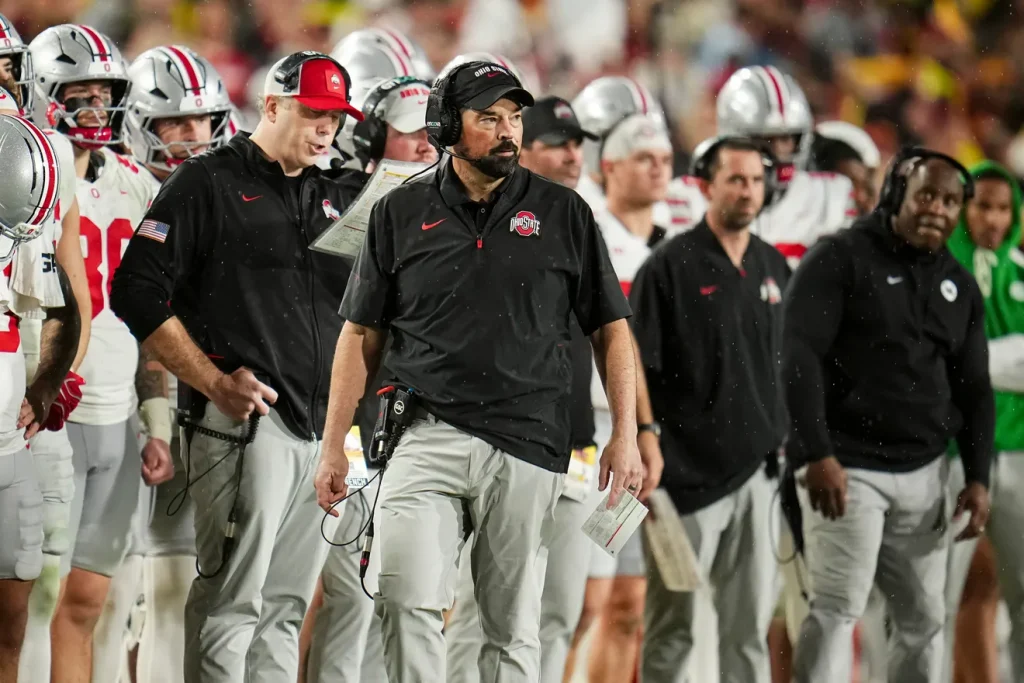
Adam Cairns/Columbus Dispatch
Ryan Day faces a trust test at Ohio State as the Buckeyes evaluate their coaching staff, confront offensive struggles and look to restore confidence after their loss to USC.
Ryan Day knows what Ohio State expects. He has spent 10 years in Columbus, understands the pressure that comes with the job, and knows what happens when the Buckeyes lose a game they are expected to win. Questioning whether Day understands the standard is the wrong conversation.
The harder question is whether everyone inside the program understands it — and whether the coaching staff is doing enough to hold the players to it.
Ohio State has lost four of its last 10 games. The losses to Indiana in the Big Ten Championship Game, Miami in the Cotton Bowl, Texas in September, and USC last Saturday came in different circumstances, but the most recent performance brought familiar concerns back to the surface.
The Buckeyes looked unprepared, played without enough urgency, and failed to respond when USC took control. Christian Alliegro put the frustration into words after reviewing the film.
“The lack of effort was probably the most disappointing thing throughout the whole game,” Alliegro said.
Alliegro’s assessment is difficult to hear from a player, especially at Ohio State. The Buckeyes have enough talent to compete with anyone in the country. They have experienced players who have played in championship games and won a national title. They should not look overwhelmed by the moment.
Ohio State added 51 new players this season. That is a substantial roster turnover, and it is fair to wonder whether every newcomer has fully grasped what playing at Ohio State requires. The standard, however, does not change because the roster does. Players who come to Columbus through the transfer portal, true freshmen, and returning veterans are all expected to meet it.
Ryan Day understands that expectation. He has been around long enough to know, and his record at Ohio State gives little reason to question whether he takes it seriously. The responsibility falls on him to make sure the players and coaches are meeting it.
Day also appeared willing to take the heat for the people around him. At Tuesday’s press conference, he fielded questions about the team’s performance, the offensive line, and potential staff changes without publicly blaming his assistants or players. He took responsibility for the program, as a head coach should.
But protecting his staff at the podium does not remove the responsibility to evaluate its performance behind closed doors.
Ohio State fans have watched this program win a national championship, compete for Big Ten titles, and recruit at an elite level. They know what the Buckeyes are capable of. The frustration comes from watching a team with that much talent look unprepared and inconsistent. Fans don’t want another reminder of the program’s potential. They want to see it on the field.
The Buckeyes are 6-2, and their goals remain attainable. But the USC loss damaged the confidence fans have in this coaching staff. Day and his assistants have to show they can correct the problems and get this team playing to its potential.
Ohio State’s Offensive Line Is Holding Back the Entire Offense
The offensive line is the most pressing issue because its struggles are affecting everything the Buckeyes want to do offensively.
Ohio State has playmakers across the board in an offensive system with concepts designed to create opportunities downfield, attack defenses at multiple levels, and use the running game to keep opponents off balance. The problem is that those concepts need time to develop. Ohio State has not consistently given its quarterbacks that time.
Lapses in pass protection are disrupting the timing of the offense. When the pocket breaks down before a route develops, the quarterback has to abandon the progression, get rid of the ball early, or try to create something outside the structure of the play.
Protection issues also affect what Arthur Smith can call. When the offensive line cannot consistently hold up, Smith has to account for pressure in the play design. Keeping a running back or tight end in to block takes another target out of the passing game.
Shortening routes limits how much time receivers have to separate downfield. The offense loses some of the options that make it difficult to defend. Ohio State has the personnel to attack defenses at every level, but the protection has to give those plays time to develop.
The result is an offense struggling to play with efficiency, and Ohio State’s loss to USC illustrated the problem. The Buckeyes finished with 464 total yards, ran 81 plays, and held the ball for nearly 40 minutes. They rushed for 204 yards, but the offense scored only 18 points.
Production between the 20-yard lines did not translate into enough points, and the passing game never established the consistency needed to put USC under sustained pressure. Luke Fahey was making his first career start, and the freshman needed a cleaner pocket and more dependable protection.
The offensive line is not responsible for every failed drive, penalty, or missed opportunity. But its inconsistency adds pressure on the quarterback, limits the passing game, and makes the entire offense harder to run.
Tyler Bowen’s evaluation should be one of Day’s priorities. He joined Ohio State in 2025 as offensive line coach and run game coordinator. His first season included Carson Hinzman earning first-team AFCA All-America recognition, Luke Montgomery and Austin Siereveld earning All-Big Ten honors, and Bo Jackson rushing for 1,090 yards.
Bowen’s unit also allowed just over one sack per game during the regular season. However, surrendering five sacks each against Indiana and Miami ultimately ended the 2025 season when it mattered most.
Ohio State’s offensive linemen are not incapable players. Several have starting experience, and some were part of the team that won the national championship. Ohio State recruited these players because the staff believed they could play at this level.
At what point does the conversation shift from the players to the coach responsible for developing them?
Bowen’s job is to get the best five linemen on the field, prepare them for the defenses they face, and build a unit that can execute consistently. Ohio State has had stretches when the line has done those things. Too often, the group has struggled with communication, protection, and sustaining blocks.
The Buckeyes need more than occasional stretches of good line play. They need five players who can give Luke Fahey a dependable pocket and allow the offense to run the concepts Smith wants to call. Until that happens, the offense will continue to operate below its potential.
Bowen shouldn’t be judged on one bad night, but the line’s uneven play is no longer a small concern. It is one of the biggest problems Day needs to solve.
Arthur Smith Has to Make His Experience Count
Ryan Day hired Arthur Smith to bring experience to the offensive coordinator position. Smith arrived in Columbus after serving as an NFL offensive coordinator with Tennessee and Pittsburgh and spending three seasons as the Atlanta Falcons’ head coach.
The move made sense. Smith had coached at the highest level, worked with established NFL quarterbacks and running backs, and built productive rushing attacks. Day wanted an experienced offensive mind who could take ownership of the offense.
Smith’s experience should help the offense adjust. Ohio State cannot keep running into the same protection problems and expect the quarterback to overcome them. The staff needs to build answers into the game plan, use its personnel creatively, and find ways to get the ball out of Fahey’s hands.
Smith has not been in Columbus long enough to receive a final verdict. The offense has been mostly effective, and the running game has shown it can do enough. But the USC loss exposed the gap between moving the ball and scoring enough points to win.
Ohio State had 464 yards, 25 first downs, and nearly 40 minutes of possession against the Trojans. The Buckeyes scored three field goals before their lone touchdown came with just over two minutes remaining. The offense had chances, but it didn’t put enough pressure on USC to change the game.
Offensive line protection issues make Smith’s job harder, but they don’t remove his responsibility to adapt. The staff has to find ways to move the ball, use formations and personnel to help the line, and build a plan that accounts for the protection problems.
The question for Day is whether the offensive structure he built is putting Smith and the rest of the offense in the best position to succeed.
Oregon Will Test Ohio State’s Response
Ohio State does not have the luxury of spending the next month looking back at USC. The first College Football Playoff rankings placed the Buckeyes at No. 12, just outside the projected 12-team field, while Oregon ranked No. 23.
The Buckeyes still have four regular-season games remaining. Winning out would put them in position to reach the playoff and compete for a Big Ten championship. The season is not over, and the players know what is at stake.
But the focus has to stay on Oregon. The Buckeyes need to play with urgency, clean up the mistakes, and look like a team that understands the opportunity in front of it.
Ryan Day sounded eager to move on from USC during his press conference. He knows the schedule does not wait for a team to feel better about itself. The response will say more than another round of explanations.
Day has earned the benefit of the doubt through a decade of work and a national championship. He should get the opportunity to lead this team through a difficult stretch. But trust isn’t permanent, and it doesn’t excuse the staff from answering for a performance like the one against USC.
Ohio State does not have to answer every question about its coaching staff in one game. It does have to show that the USC performance was an outlier and that it is addressing the problems exposed in Los Angeles. The offensive line needs to protect the quarterback, so the offense can execute its concepts.
Ryan Day’s team needs to play with the effort and preparation expected of Ohio State. The result against Oregon will not settle every debate surrounding Day’s staff. But it will give fans a better idea of whether this team can respond when its season is on the line.

Blake Biscardi serves as Co-Founder, Lead Reporter, and Senior Editor of The Silver Bulletin. He hosts the Buckeye Cadence podcast, where he breaks down Ohio State football and basketball with an inside look into the programs. Covering Julian Sayin in New York City in 2025 was his Heisman moment, which became a viral moment in its own right. Biscardi is a member of the Football Writers Association of America (FWAA) and has degrees in Business Administration and Strategic Communication & Leadership.
Discover more from The Silver Bulletin
Subscribe to get the latest posts sent to your email.