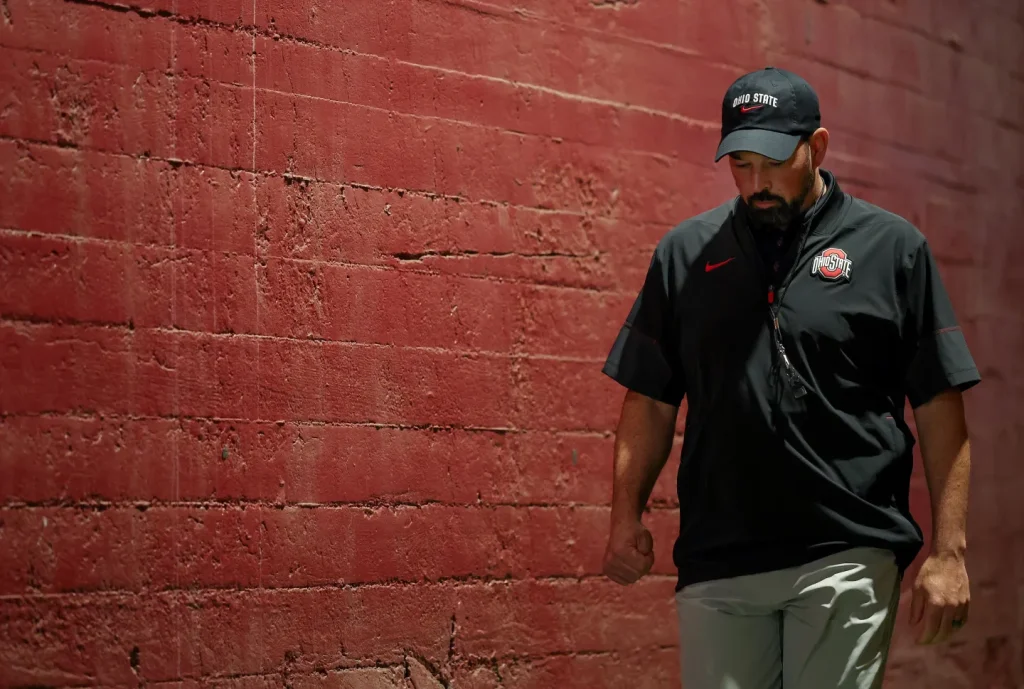
Ohio State football has four games left, and Ryan Day must address offensive line struggles, red-zone execution, and coaching accountability.
The Buckeyes have four games to determine their postseason destination after falling to 6-4 in their last ten games. Ryan Day’s decisions now will determine whether Ohio State can correct its shortcomings and compete to achieve its goals.
Ohio State is 6-2 following Saturday’s 30-18 loss to USC, and the problems exposed in Los Angeles have followed them through much of the fall. Ryan Day now faces decisions about the direction of his offense, the responsibilities of his coaching staff, and how aggressively the program will address issues that have persisted against its toughest opponents.
The Buckeyes host Oregon on November 7 before closing the regular season against Northwestern, Nebraska and Michigan. Winning all four would put Ohio State at 10-2 and in position to compete for a Big Ten Championship and a College Football Playoff berth. Two more losses would leave the Buckeyes 8-4, with a postseason destination far removed from the expectations surrounding the program in August.
Every possible outcome remains in front of them.
Difference Between Moving the Ball and Winning Games
Ronald Reagan’s 1964 speech, A Time for Choosing, challenged Americans to consider the direction they wanted to take and the consequences of the decisions ahead. Ohio State faces its own crossroads to a much lesser extent. The program must determine what it wants its offense to look like, whether its current coaching structure is producing the necessary results, and how much change is required to get there.
The loss to USC exposed the gap between Ohio State’s offensive production and its ability to finish possessions. The Buckeyes gained 464 yards, recorded 25 first downs, and held the ball for 39:28. Bo Jackson rushed for 121 yards, Luke Fahey threw for 260 in his first career start, and Jeremiah Smith caught 10 passes for 83 yards and a touchdown.
That production should have produced more than 18 points. Four of Ohio State’s five scoring drives ended in field goals, and the offense converted only one of four red-zone opportunities into a touchdown. The most baffling sequence came late in the first half, when the Buckeyes reached the USC 1-yard line with a chance to close the gap before halftime.
After a review placed Fahey short of the goal line, Jackson was stopped for no gain. A false start moved Ohio State back to the 5, and consecutive incompletions left Connor Hawkins to kick a 23-yard field goal. The Buckeyes had driven 53 yards and spent more than four minutes moving downfield, only to leave with three points.
The possession encapsulated recurring problems with short-yardage execution, penalties, and play selection. Ohio State had an opportunity to use its physical advantages near the goal line, but the sequence ended with another field goal. The offense moved the football against USC, but it failed to execute in the red zone.
Protection, Personnel and an Offense in Search of an Identity
The offensive line’s performance added another layer to the problem. According to Bill Landis, citing PFF data, USC generated pressure on 47.6 percent of Ohio State’s dropbacks, the third-highest pressure rate allowed by a Buckeyes team under Day. Only the 2024 loss to Michigan, when Ohio State allowed a 50 percent pressure rate, and the 2023 loss to Missouri, at 48.3 percent, were worse.
Highest pressure rates allowed by Ohio State under Ryan Day (per PFF):
1. 2024 Michigan: 50%
2. 2023 Missouri: 48.3%
3. 2026 USC: 47.6%All losses, obviously.
Ohio State has allowed a pressure rate of 42% or higher 9 times since 2019. It’s 2-7 in those games.
3 of the 8 games with the highest pressure rate allowed since 2019 are from this season: USC, Texas, Iowa
— Bill Landis (@BillLandis25) November 2, 2026
Landis shared that Ohio State has allowed pressure rates of at least 42 percent nine times since 2019 and is 2-7 in those games. Three of the eight highest pressure rates allowed during that span have occurred this season against Texas, Iowa and USC. The pattern points to a vulnerability opponents have repeatedly exploited, particularly when the Buckeyes need to sustain drives or protect a lead.
Pressure disrupts timing, limits a quarterback’s ability to work through progressions, and makes longer-developing concepts harder to execute. It also complicates the run game when defenses can attack the line of scrimmage with confidence. Jackson’s 121-yard performance against USC was encouraging, but the protection problems are a concern that cannot be separated from the offense’s struggles in critical situations.
Tyler Bowen, the offensive line coach and run game coordinator, has to find a more reliable combination of protection and run blocking. Keenan Bailey, who oversees the tight ends and serves as co-offensive coordinator, must evaluate how his position group fits into the blocking structure and passing game.
Ohio State has leaned heavily on 12- and 13-personnel groupings, but the tight ends have not established themselves as dependable contributors. The current group has struggled to influence games as blockers and pass catchers, and the personnel may not be the best fit for an offense that needs to create more space for its receivers.
Injuries to Brandon Inniss and Brock Boyd have limited the staff’s options in recent weeks. Even so, Ohio State has a deeper collection of wide receivers than it has consistently used. Getting more of those players involved can create better spacing by forcing defenses to account for additional threats and making heavier formations less predictable.
Arthur Smith deserves scrutiny alongside Bowen and Bailey. As offensive coordinator, Smith is responsible for shaping a system that fits the players available. The run game produced 204 yards on 43 carries against USC, but the offense still struggled with play sequencing and red-zone execution. The staff has to find a better balance between its personnel groupings, its running game, and the opportunities available to its receivers.
Billy Fessler faces an immediate challenge in developing Fahey. Julian Sayin’s absence changes the offense’s capabilities, and the freshman shouldn’t be expected to replicate Sayin’s production. Fahey completed 21 of 38 passes for 260 yards against USC and threw Ohio State’s only touchdown pass. He had some misfires, and the receivers dropped passes, but he still moved the offense despite a difficult environment and circumstances.
The staff needs to build around Fahey’s strengths. Quick-game concepts, movement, defined reads, and a consistent run threat can help him set his feet and get the ball out.
Decisions Ryan Day Can No Longer Avoid
Day’s postgame explanation about tempo deserves a closer look. He said Ohio State did not want to panic and move into its tempo offense with a young quarterback before the situation demanded it. The staff wanted to pick up a first down and build the pace from there, but the Buckeyes went three-and-out on the next possession.
Midway through the third quarter, the deficit had grown to 18, and the clock had become an opponent. Still, Ohio State neglected to operate with urgency, which was understandable to a degree, with Fahey making his first start on the road. However, in gotta-have-it situations, that cannot be the case.
Has caution become too prominent in an offense that used to and needs to create advantages? Ohio State has not played with urgency consistently, and the measured approach against USC raised a broader question about how the staff wants to operate.
Ryan Day discussing Ohio State’s pace of play late in the game against USC: https://t.co/ouTlh0JlyV
— Blake T. Biscardi (@BlakeBiscardi) November 1, 2026
Day built his reputation on offensive innovation, quarterback development, and creating difficult matchups for opposing defenses. His offenses have often been most dangerous when they play with rhythm, stretch the field, and pressure defenses through tempo and creativity.
Has the effort to adopt a more professional, NFL-style structure slowed the operation and made it more deliberate at the expense of some of those strengths?
Maybe through an overcorrection, Ohio State has leaned into heavier formations even as its tight ends have struggled. The offense has also been reluctant to use tempo consistently. Efficiency does not require conservatism. Day and Smith need to identify where calculated risks can create advantages, whether through personnel groupings, play sequencing, or attacking before a defense is fully set.
Day acknowledged after the Texas loss that the offense and its play calling ultimately fell under his responsibility. He also said the staff had to determine whether its problems came from execution, coaching or scheme. In September, he said, “We have to justify our coaching.” Six weeks later, the Buckeyes are still searching for answers in several of the same areas.
The responsibility cannot be placed solely on the assistants. Day oversees the program, hired the staff, and has final authority over the offensive direction. Criticism of Smith, Bowen, Bailey and Fessler is warranted, but the head coach must examine his own decisions with the same scrutiny. He does not need to dismiss assistants in November. But he does need to determine whether the current structure gives Ohio State its best chance to win.
Matt Patricia’s defense also needs a more honest evaluation. USC scored on a 69-yard touchdown pass on its second offensive play and repeatedly found opportunities to attack Ohio State in space. The Trojans gained 338 yards on only 50 plays, averaging 6.8 yards per snap. However, 139 yards came on two plays.
Missed assignments, communication breakdowns, and defenders trying to make hero ball plays on their own let USC turn opportunities into explosive gains.
Jay Timmons’ absence hurt the secondary, but it cannot explain every breakdown. Ohio State also needs better tackling and more disciplined coverage. Matt Patricia’s unit has generally kept opponents from producing at a high rate, but the lapses against USC showed how quickly the defense can surrender control when its assignments break down.
Special teams need attention as well. Robby Discher’s unit allowed a 44-yard punt return and committed an inadvertent fair catch signal late in the game. On the bright side, Connor Hawkins made all four of his field goal attempts in a rainy road environment.
Four Games to Determine What Comes Next
Ohio State’s season is still alive. The Buckeyes control their path to the Big Ten Championship by winning their remaining games, and a 10-2 finish would strengthen their College Football Playoff case. The national picture is unsettled, but Ohio State cannot depend on other teams losing to compensate for its own shortcomings.
Oregon is the first opportunity for the Buckeyes to respond. The Ducks will test the offensive line, using their defense to create pressure and havoc. Ohio State needs more dependable red-zone execution and a defense that plays as a team and makes tackles instead of reaching for highlights. Northwestern, Nebraska and Michigan follow, leaving zero room for another performance defined by missed opportunities.
The next month requires more than another promise to correct mistakes. Ohio State needs an offensive identity that fits its personnel, a coaching staff willing to challenge its own assumptions and a team capable of executing when the game hangs in the balance.
The decisions begin with Oregon. Day must determine how much of the current offensive structure he is willing to change, which coaches need to adjust their approach, and whether he will trust the offense to take calculated risks before the game forces his hand. His answers will shape the final four games and establish what this program believes it needs to become.

Blake Biscardi serves as Co-Founder, Lead Reporter, and Senior Editor of The Silver Bulletin. He hosts the Buckeye Cadence podcast, where he breaks down Ohio State football and basketball with an inside look into the programs. Covering Julian Sayin in New York City in 2025 was his Heisman moment, which became a viral moment in its own right. Biscardi is a member of the Football Writers Association of America (FWAA) and has degrees in Business Administration and Strategic Communication & Leadership.
Discover more from The Silver Bulletin
Subscribe to get the latest posts sent to your email.