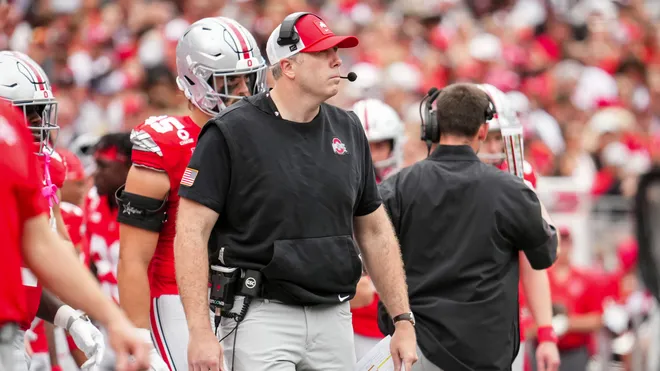
Arthur Smith explains how Ohio State will adapt its offense without Julian Sayin, including the quarterback competition, running game, and USC matchup.
COLUMBUS, Ohio — Ohio State will not ask Luke Fahey or Tavien St. Clair to become Julian Sayin. Offensive coordinator Arthur Smith made that clear Tuesday as the Buckeyes began preparing to play the remainder of the season without their starting quarterback.
Smith’s approach is to identify what each quarterback does best, adjust the offense accordingly, and maintain the expectations that have guided the program through the first half of the season.
“You’re not asking them to be Julian. You’re asking them to be themselves,” Smith said Tuesday after practice.
Ryan Day confirmed that Sayin is out indefinitely and said Ohio State is preparing for the possibility that he will miss both the regular season and postseason. Day has not provided a recovery timeline, leaving Smith and the offensive staff to prepare for a different quarterback leading the offense moving forward.
Sayin’s production illustrates the challenge Ohio State faces. Through seven games, he completed 131 of 192 passes for 2,007 yards and 19 touchdowns with four interceptions, averaging 286.7 passing yards per game. The Buckeyes averaged 39.3 points and 476.3 total yards per contest before his injury.
Replacing that production will require more than identifying a capable passer. Ohio State must determine how its offensive structure, play selection, and supporting cast can help a less experienced quarterback operate against an experienced USC defense.
Arthur Smith Will Build Around His Quarterback’s Strengths
Smith has spent his coaching career working with quarterbacks of different backgrounds and skill sets, including during his time in the NFL. He said adapting the offense to the personnel available is a fundamental responsibility of the coaching staff, not an entirely new challenge created by Sayin’s injury.
“You always want to adapt to whoever’s back there,” Smith said. “It’s not just like, here’s the playbook. It’s one size fits all.”
That philosophy will guide the competition between Fahey and St. Clair during the bye week. Fahey entered the Indiana game ahead of St. Clair on the depth chart after consistently performing better in practice over the preceding month, according to Day.
The freshman was thrust into a competitive situation late in Ohio State’s 19-15 win, giving the coaching staff its first extended look at him under pressure.
St. Clair offers a different physical profile. Smith highlighted the sophomore’s arm strength and ability to extend plays, giving Ohio State another option as it evaluates how to structure the offense.
“There [are] strengths to both him and Tavien,” Smith said. “Luke in particular, the way that Luke prepares…for a guy that is young, he has a pro mindset.”
Smith added that St. Clair has a big arm and can extend plays, describing the two quarterbacks as different players with qualities the staff likes.
Those differences could influence how Ohio State approaches its next game. A quarterback who is comfortable operating within the pocket may require a different mix of concepts than one who can create outside the structure of a play. The staff will also need to consider each player’s command of the offense, decision-making, and ability to handle pressure.
Smith did not outline specific changes. Instead, he said the Buckeyes will evaluate both quarterbacks and make adjustments based on what they do well.
“Things that we do well, I mean, that’s what they’ve been practicing, too,” Smith said. “Maybe it’s a little bit of what you call with them, things that we’re used to and some things we may add or change up.”
The objective is to preserve the offense’s identity while putting the eventual starter in a position to succeed.
Ohio State Must Find More Consistency & Efficiency in Run Game
The quarterback situation also puts greater emphasis on Ohio State’s ability to establish the run. Smith acknowledged that the offense could look different without Sayin, but he pushed back against the idea that the quarterback’s absence changes the team’s fundamental expectations.
“The expectations don’t change,” Smith said. “You just try to play to the strengths of your offense, and regardless of who’s out there.”
He emphasized that even elite quarterbacks need a productive running game, stressing the importance of balance regardless of who takes snaps. “You could have Aaron Rodgers or Peyton Manning out there, whoever, and you still need a good run game,” Smith said.
Ohio State has averaged 153.1 rushing yards per game through seven contests, gaining 1,072 yards on 268 attempts, and scoring 13 touchdowns.
Bo Jackson has been a productive option in the backfield, and the offensive line has experience that Smith believes can help the team navigate the transition. Ohio State rushed for 207 yards against Maryland earlier this season, demonstrating the group’s potential when the run game establishes a rhythm.
The challenge is sustaining that production against stronger opponents and avoiding situations that force a young quarterback into obvious passing downs. Defenses can crowd the line of scrimmage if Ohio State struggles to run effectively, but a consistent ground game can create more manageable third downs and opportunities for play-action.
Smith left open the possibility of changing the offensive approach, saying the staff has two weeks to prepare for USC and determine what adjustments make sense. He did not commit to a heavier run-first offense.
Supporting Cast Must Help the New Quarterback
Ohio State’s offense can’t put the entire burden of replacing Sayin on Fahey or St. Clair. Smith stressed that the other 10 players on the field must execute at a high level, especially with a young quarterback learning to handle a starting role.
“Anytime you’re playing with a young guy, I mean, it could be like I said, you could put Joe Montana in there as a rookie, first-year player, second-year player, and you still have to adapt to his strengths,” Smith said.
He added that experienced players must provide leadership across the offense. Ohio State has an established game-changing receiving threat in Jeremiah Smith. His ability to win contested catches and create explosive plays makes him the ultimate target for either quarterback, though the Buckeyes will need to avoid becoming overly dependent on one receiver.
The offensive line also has a responsibility to help control the game. Better protection would give the new quarterback additional time to work through progressions, while a productive running game could reduce the number of high-pressure passing situations he encounters.
Smith said the coaching staff will keep making week-to-week adjustments, as it has throughout the season. The circumstances are different now, but the underlying process remains the same.
Ohio State’s Championship Expectations Remain
The bye week gives Ohio State time to evaluate its options before facing USC, but the Buckeyes cannot afford to spend that time searching for a direct replacement for everything Sayin provided.
Day said both quarterbacks would receive first-team reps during the bye week, with the final decision based on which player gives Ohio State the best chance to win. For the Buckeyes, the transition will require a combination of sound quarterback play, a more consistent running game, and dependable execution across the offense.
Smith understands how difficult it is to lose a starting quarterback in the middle of a championship pursuit. He also knows the team can’t let that setback dictate the rest of its season.
“The ball’s getting kicked off, and we’re going to go out there with the expectation to win and play at a high level,” Smith said.

Blake Biscardi serves as Co-Founder, Lead Reporter, and Senior Editor of The Silver Bulletin. He hosts the Buckeye Cadence podcast, where he breaks down Ohio State football and basketball with an inside look into the programs. Covering Julian Sayin in New York City in 2025 was his Heisman moment, which became a viral moment in its own right. Biscardi is a member of the Football Writers Association of America (FWAA) and has degrees in Business Administration and Strategic Communication & Leadership.
Discover more from The Silver Bulletin
Subscribe to get the latest posts sent to your email.