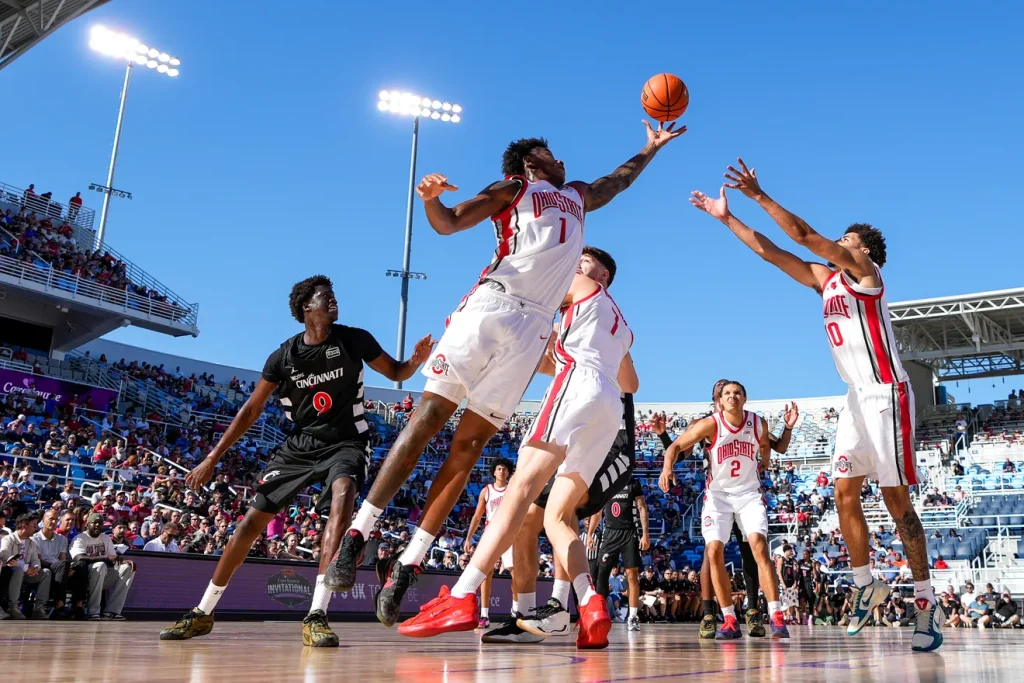
Ohio State men’s basketball’s roster for the 2026-27 season looks different from last year’s. Jake Diebler mentioned 3 areas of improvement for the Buckeyes.
MASON, Ohio – The Buckeyes added size, playmaking, and depth. Diebler also believes the roster gives Ohio State more positional flexibility than it had during his first two seasons. Now, the questions shift from what Ohio State added to how quickly those pieces can become a functional team.
Diebler said the rotations are still being finalized, with multiple players competing for minutes and opportunities in the preseason. Wednesday’s exhibition against Cincinnati in the CareSource Invitational provided us with a first look at the Buckeyes in action.
Here are three things to watch as the Buckeyes head into the 2026-27 season, plus a few quick takeaways from the game in Mason, Ohio.
1. How much can Ohio State’s versatility change the way it plays?
Versatility was one of the biggest areas Ohio State addressed during the offseason. Jake Diebler started John Mobley Jr., Curtis Givens, Anthony Thompson, Amare Bynum, and Ivan Njegovan against the Bearcats; however, he said not to read too much into it, as the Buckeyes are still experimenting.
“I would not put a penny’s worth of stock in who we started, who came off the bench first, none of that,” Diebler said. “I think we’ve got a few guys who have solidified a starting position, and then we’ve got a lot of competition happening right now.”
At Team Media Day, Diebler identified two problems from last season: the Buckeyes needed more playmaking outside of Bruce Thornton, John Mobley Jr., and Christoph Tilly, and they needed to get bigger. Ohio State believes it addressed both.
Amare Bynum can play multiple positions. Anthony Thompson gives the Buckeyes a 6-foot-9.5 option with positional flexibility. Andrija Jelavic brings a 6-foot-11 frame, a wingspan of more than seven feet, and the ability to play multiple positions. Josh Ojianwuna can defend across the floor, while players like Lee Aaliya and Alex Smith add size and athleticism.
Ohio State can play big at the wing and both forward positions for extended stretches. It can also downsize when necessary. The roster’s versatility also depends on individual development. Diebler specifically pointed to Bynum’s continued growth as something that can expand the number of ways Ohio State uses him.
2. Who becomes Ohio State’s offensive creator?
Bruce Thornton was Ohio State’s primary playmaker last season. Replacing his production is not about finding another player to replicate his role. Instead, the team spreads playmaking across the roster.
Mobley enters the season as one of the team’s most proven players, while Justin Pippen has continued to develop after playing major minutes in the ACC last season. Both will be major contributors this season. Diebler said Pippen has improved as a three-point shooter, decision-maker, and ball-screen player, and has shown he can create for himself and others.
John Mobley Jr. and Justin Pippen spent the most time on the floor on Wednesday. Mobley led the Buckeyes in scoring with 15 points, while Pippen added 8 with three important rebounds.
Diebler said the team’s playmaking level rises when the two are together. Both can shoot, create for teammates, and attack the paint, giving Ohio State two players who can initiate offense.
Justin Pippen gets the and-1 for the Buckeyes.
Outdoor basketball! 🏀 https://t.co/iK6Z1N1aYU
— Blake T. Biscardi (@BlakeBiscardi) October 7, 2026
Freshman LJ Smith will also factor into the offensive equation. Diebler praised his maturity and ability to play on and off the ball, but stressed that the 17-year-old still needs to become a more consistent producer. The freshman scored 9 points on 4-for-11 shooting against Cincinnati.
Ohio State’s offense will also look different structurally. Diebler said last year’s offense was more set-action heavy. This year’s version is more concept-driven, asking players to read situations and react rather than simply execute predetermined actions.
The coaching staff has started adding more set actions as the preseason progresses, including ways to get Mobley involved when he goes multiple possessions without touching the ball. That lens is how Diebler will assess this game, given the windy, sunny outdoor conditions.
Overall, he was pleased with some of the looks and said not to read too much into the perimeter shot-making, or lack thereof. “We are a much better shooting team than 4-for-23 from 3 and however many airballs we had,” Diebler said.
“I thought we manufactured some great looks,” Diebler said. “We wanted to shoot the right shots. If it was windy or glaring, we wanted to do it the right way. We had some paint-touch threes that [in practice] we make those.”
Diebler acknowledged the offense is still a work in progress and expects it to continue developing through November and the early portion of the season.
3. Can Ohio State turn its depth into a defensive identity?
Ohio State wants to pressure teams for 40 minutes. Diebler said the Buckeyes now have enough depth and athleticism to defend full court, something he wanted to implement after seeing opponents use pressure against Ohio State last season.
Justin Pippen, Curtis Givens, LJ Smith and Juni Mobley give Ohio State multiple options to pick up opposing guards. Rather than relying on one or two players to carry the defensive workload, Diebler can rotate fresh bodies onto the ball.
Diebler pointed to the effect pressure can have over the course of a game, particularly against teams that rely heavily on one guard. Ohio State wants to make opponents work to bring the ball up, attack through pressure, and deal with fresh defenders throughout the game.
Diebler said the defense has improved since the summer and that Ohio State is trying to become more disruptive while using its size and length more effectively. However, the defense struggled in the second half, particularly inside the paint, and also had rebounding issues.
“Those guys didn’t have a good day today,” Diebler said, “It is what it is. That’s not how they’ve been or how they’ve played and [it] won’t be how they play moving forward.”
Still, Diebler expressed confidence in the big men and noted Ojianwuna shook off some nerves after missing over a year with a knee injury. As Ohio State’s defense becomes more aggressive, the offense must improve its reads and execution under pressure. That competition should continue through the preseason as Diebler determines his rotation.
The final minutes were valuable: Cincinnati erased Ohio State’s 8-point lead on a 24-8 run, putting pressure on the Buckeyes and creating a situation hard to simulate in practice. That led Diebler to put players like Mobley and Bynum back in to gain experience, knowing they’ll need to close games during the season.
“That second half is going to be so valuable for us, way more valuable than the first half when we were winning,” Diebler said. “I think that’s what we’ll take from this.”
Diebler said, “We handled it well at times; I thought late we didn’t handle it as well as we needed to [as we did] earlier in the game.”
Ohio State has two more exhibition or scrimmage opportunities to evaluate its roster before the regular season. Diebler will use those games to continue sorting out the rotation and finding the combinations that give the Buckeyes their best chance to win.

Blake Biscardi serves as Co-Founder, Lead Reporter, and Senior Editor of The Silver Bulletin. He hosts the Buckeye Cadence podcast, where he breaks down Ohio State football and basketball with an inside look into the programs. Covering Julian Sayin in New York City in 2025 was his Heisman moment, which became a viral moment in its own right. Biscardi is a member of the Football Writers Association of America (FWAA) and has degrees in Business Administration and Strategic Communication & Leadership.
Discover more from The Silver Bulletin
Subscribe to get the latest posts sent to your email.