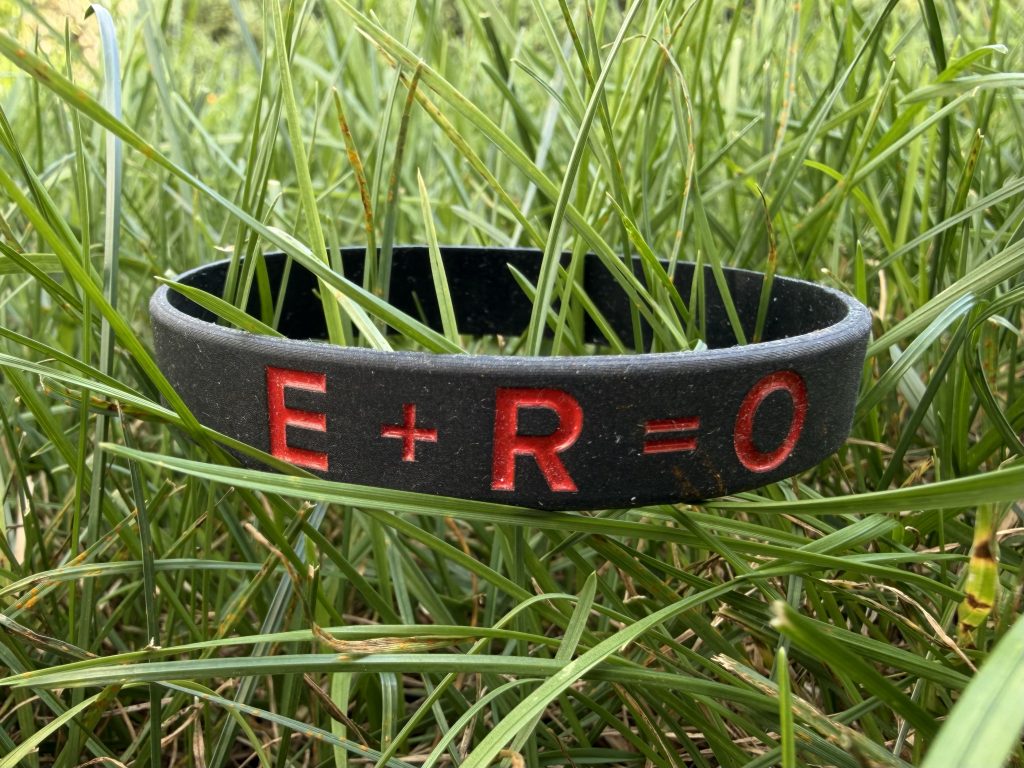
I have worn the same wristband every day since August 2014. It is black with red letters that read “E + R = O.”
Event + Response = Outcome.
I was 15 years old when I discovered an equation while watching Ohio State football. I thought I was learning how a team responded to adversity, but I had no idea I was learning how to understand people.
What I remember most about Ohio State’s 2014 championship run is not winning the national championship. It is everything the Buckeyes had to overcome to get there.
Braxton Miller got hurt before the season, and I remember immediately wondering, What are they going to do? Are their chances over?
J.T. Barrett stepped in and led Ohio State to the Big Ten Championship Game, overcoming one obstacle after another along the way. Then Barrett went down with a season-ending injury against Michigan, and Cardale Jones had to take over.
Three games later, Ohio State was the national champion.
There was more to overcome than injuries and uncertainty. The team was dealing with the death of teammate Kosta Karageorge the week of the Michigan game. As a 15-year-old watching it unfold, I saw a story of resilience and a team continuing to respond to circumstances it could not control.
I did not yet have the language for what I was seeing.
That changed in August 2014. I saw an Instagram post about The R Factor, a philosophy developed by Tim Kight. At the center of it was an equation: E + R = O – Event + Response = Outcome. When I first read it, I saw the words, but the team’s performance brought them to life.
What captured my attention was that it was a system. It gave me a practical way to think about something that otherwise felt abstract: how to respond to life. I wanted to know more, so I researched Tim Kight and his company, and reached out to him and his son, Brian, on Instagram and asked a few questions. I studied their material, listened to their podcast, read their notes, and took their trainings throughout high school and college.
Tim eventually became a mentor to me, and he has remained one ever since. He became one of the wisest voices in my life and even mentored me through my master’s capstone project.
I have carried what I learned from him into the baseball teams I coach, the ministry teams I lead, and into my work here at The Silver Bulletin. I have also shared E + R = O with players, friends, coworkers, and peers, which is why I have bought hundreds of the same wristbands over the years and handed them out while telling them the story of the one I never take off.
The wristband is a reminder of my relationship with Tim and what I learned from him. More than anything, it reminds me to press pause, get my mind right, and respond.
I needed that system in college, and again during one of the most difficult seasons of my life in the spring of 2025. I did not need another explanation of the equation at the time – I needed the reminder.
E + R = O was never just about football, or even about hard seasons. It was a way of paying attention – to why people respond the way they do. Once I had that lens, I couldn’t turn it off, even when I picked up a microphone or a pen instead of just handing someone a wristband.
That way of thinking eventually became part of the way I approached journalism. I did not take the traditional journalism route and go to school to learn how to write an article, conduct an interview, record a podcast, film a stand-up, or do a live hit. Those skills had to be built.
Talent is a gift, but building skill is a choice.
I have always loved writing, speaking, and having conversations. But I had to learn how to turn those abilities into a craft. I had to search for conversations, observe, ask questions, learn, and grow. Somewhere along the way, I realized that I was beginning to watch Ohio State the same way I had learned to watch life.
When you are young and grow up rooting for a team, you look up to the players and coaches and want to be them. As you get older, you start wondering how they got there and what they had to do to get there.
Eventually, you wonder why.
That question is what drives me now. The first time I walked into the Ohio State football facility as a member of the media, I felt grateful to the people who helped me get there. I thought about the journey that led to that moment. But what struck me as I walked through the building was something deeper.
The messaging and signage on the walls were not just poster values. They were heart values. The players and staff believed them and lived them every day. They were not words displayed to create an appearance. They were reflected in how people carried themselves and treated one another.
I was inside the building where I had spent years watching from the outside, and I realized I was covering more than a team.
I was covering people.
Woody Hayes said, “You win with people.” That principle has been part of Ohio State for generations, and it is one of the reasons Ryan Day’s leadership interests me so much. Players, coaches, and people around the program consistently speak about him in ways that align with what I have observed myself.
I experienced that firsthand in March 2026, when I had a conversation with Day, thanking him for the way he leads Ohio State and telling him how much I had learned from being around him and his staff. I explained that I asked him leadership questions because his approach had made an impression on me. His response encapsulated it all:
“We’re all about people and relationships.”
He talked about the importance of building relationships and connecting with people in the room. He told me that 20 years from now I would be able to look back and remember the people I met and the relationships I built along the way.
“Life is about people and connection,” he said.
Then he talked about journalism. He warned against the cycle of hot takes and clickbait, pointing out how quickly that kind of coverage can burn out. Instead, he encouraged me to keep meeting people around the program, build relationships, and tell real stories about people and the game.
What struck me was not that Day had given me a new idea. It was that he had put words to something I had been learning to recognize for years.
Our conversation stayed with me because it was consistent with what I had been observing. The message matched the behavior, and the philosophy matched the people. All of that reinforced the question I had been asking since I was 15: Why? I wanted to understand the people behind it.
Why does this program operate the way it does?
Why do certain people lead the way they do?
Why does a player respond differently under pressure?
Why does Ohio State identify certain recruits, hire certain coaches, and build certain systems?
Those are the questions that make walking into the Ohio State football facility feel like research to me. I get to observe an organization operating at the highest level, and listen to its messaging, ask questions, and watch coaches, players, and staff work. I get to see the relationships and systems behind what eventually shows up on Saturday.
An elite Division I football program is a living case study in leadership, culture, team building, and human behavior. I get to watch it happen and tell people what I see, giving them a deeper understanding of who they’re actually watching.
I grew up talking about college football around a bonfire with my friends until three o’clock in the morning because that is what we loved.
Now I cover the same sport from a different side. I put the fandom aside and ask questions. I listen, observe, and learn. That does not take away what Ohio State means to me. It gives me a different way to understand it.
The access would probably enamor the kid I was. He would be surprised by the relationships and by getting to see behind-the-scenes moments, ask questions, and learn the why, the how, and the who.
But he would recognize the curiosity. That part has not changed. I am still seeking to understand. The difference is that now I have a front-row seat.
I still wear the wristband, and it is still black with red letters. I received it while watching Ohio State football in 2014, when I was 15 years old and trying to understand how a team could keep responding to everything that happened around it.
Twelve years later, I am still watching. The questions are different now. But the reason I ask them is the same. I want to understand the people.
Because the truth of Ohio State football is people.
Join Us for TSB LIVE at DICK’s House of Sport’s Tailgate Takeover

Join us at DICK’s House of Sport in Polaris, OH, on Saturday, August 29, from 12-3 pm for a Tailgate Takeover to kick off football season! TSB LIVE returns for an on-site show with special guests previewing Ohio State’s 2026 season. You do not want to miss this event! Register here
NEXT: Read Buckeyes Name Seven Team Captains for 2026 Season

Blake Biscardi serves as Co-Founder, Lead Reporter, and Senior Editor of The Silver Bulletin. He hosts the Buckeye Cadence podcast, where he breaks down Ohio State football and basketball with an inside look into the programs. Covering Julian Sayin in New York City in 2025 was his Heisman moment, which became a viral moment in its own right. Biscardi is a member of the Football Writers Association of America (FWAA) and has degrees in Business Administration and Strategic Communication & Leadership.