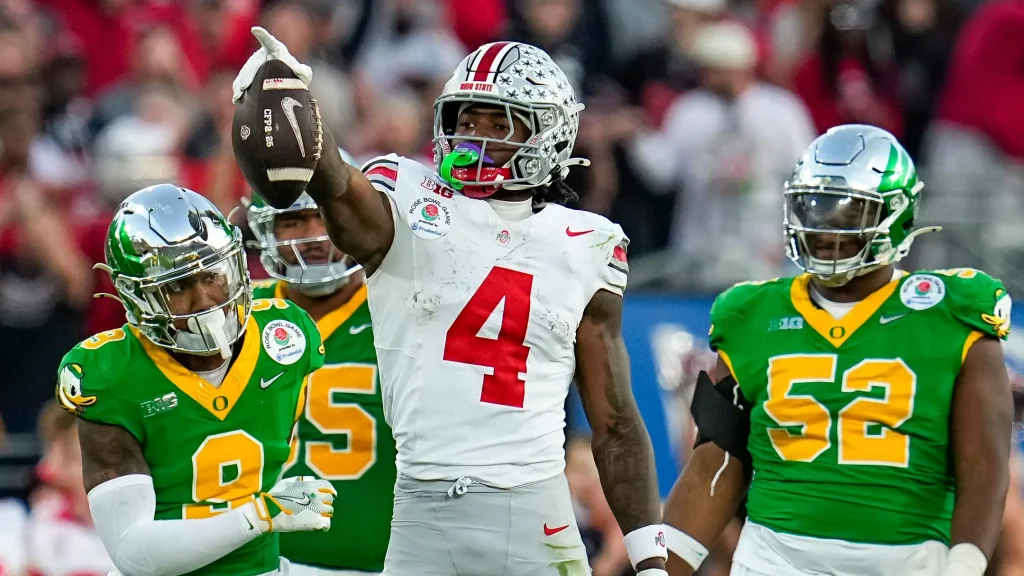
What could five years of Jeremiah Smith playing college football at Ohio State look like under the NCAA’s new 5-year eligibility rule?
Jeremiah Smith enters his junior season this fall. Two years in, and he might already be the best receiver Ohio State has ever had, according to the numbers. So let’s do something fun and pretend he doesn’t leave for the NFL after this season.
In this scenario, Jeremiah Smith uses all five years of NCAA eligibility and decides he’d rather see it through in Columbus than go to the NFL as soon as he’s eligible. It will never happen, but stay with me, because this version of the story is too good not to tell.
Here’s what makes it possible: on June 23, 2026, the Division I Cabinet scrapped the old eligibility rulebook and replaced it with a system that permits Division I student-athletes up to 5 years of eligibility if they enroll in college no later than the academic year after their 19th birthday.
Gone are the season-of-competition limits, sport-specific quirks, redshirt gymnastics, and roster scrambles. Personnel management can now adopt a new strategy across current players, recruiting freshmen, and transfer portal additions.
The old rulebook is streamlined by eliminating season-of-competition limits, sport-specific eligibility rules, redshirting, and eligibility extension waivers entirely. Smith enrolled at Ohio State right out of high school, well ahead of that 19th-birthday cutoff, which means under this new model, he has five full years.
On this week’s episode of Around the Shoe on the Bill and Doug Show, one of the questions centered on a player who would benefit from five years of eligibility, and I was given permission to explore a fun version where Jeremiah Smith exhausts his collegiate eligibility. Watch the full thoughts in the video above.
Now picture him staying at Ohio State, and the calendar turns to 2027, with the Buckeyes in the College Football Playoff. Tavien St. Clair drops back, buys a half-second in the pocket, and finds Smith working the middle of the field. Touchdown Buckeyes! In that moment, as the record boards update live on the broadcast, Jeremiah Smith becomes the all-time leading receiver in college football history. Not Ohio State history, which is projected for September or October this fall.
He does it with a full season still left to play. Running his 2025 sophomore pace of 95.6 yards per game across a five-year career, with Ohio State playing an average of 15 games per season, he lands at 7,710 receiving yards. That number is conservative because it assumes, inconceivably, that he doesn’t improve in averages. Those numbers give Smith the following records:
- 4,272 yards past Michael Jenkins, whose Ohio State record has stood since 2003
- 1,885 yards past Corey Davis, whose FBS record has stood since 2016 from his time at Western Michigan
Now picture the ramifications for Ohio State with potentially three Big Ten titles and three more shots at winning multiple national championships instead of one. St. Clair and Smith could become the most decorated quarterback-receiver duo in program history and potentially even college football history, too.
However, like all good things, this version of the story comes to an end because Jeremiah Smith is all but confirmed to leave for the NFL after this season. Still, the age-based model makes this dream a fun exercise for the best player in the nation because it could legally happen.
For the first time, “what if the best player in the country just never left” isn’t limited to a bar argument or conversation with the boys. It’s a possible, yet unlikely, reality. Under these circumstances, it would have ushered in an era of Ohio State football that would have been the most dominant run this sport has ever seen.
NEXT: Read Ross Bjork on Big Ten’s Involvement Shaping College Football: “We Should Be at the Forefront of All These Conversations”

Blake Biscardi serves as Co-Founder, Lead Reporter, and Senior Editor of The Silver Bulletin. He hosts the Buckeye Cadence podcast, where he breaks down Ohio State football and basketball with an inside look into the programs. Covering Julian Sayin in New York City in 2025 was his Heisman moment, which became a viral moment in its own right. Biscardi is a member of the Football Writers Association of America (FWAA) and has degrees in Business Administration and Strategic Communication & Leadership.