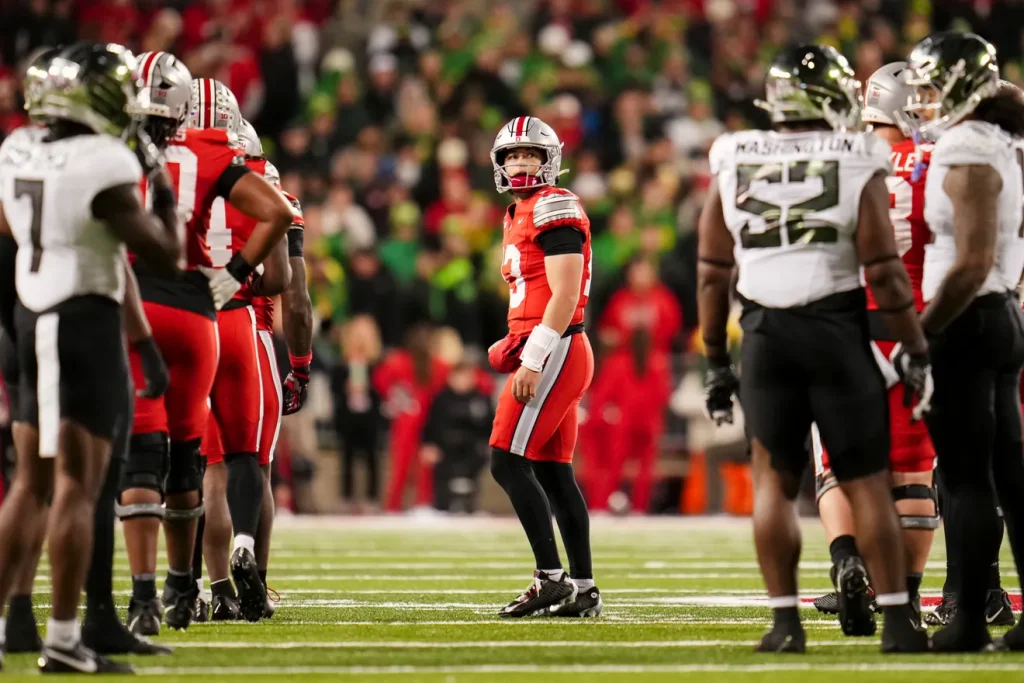
Ohio State surrendered 38 unanswered points in a 41-28 loss to Oregon and faces major questions about coaching, leadership, and the season.
COLUMBUS — Sometimes uncertainty is the best canvas for opportunity. Ohio State’s backs were against the wall, with elements of the unknown surrounding a game it needed to win as a program.
Ohio State fell 41-28 to Oregon in Ohio Stadium. The skies turned gray, with occasional rays of sunshine peeking through, as the Buckeyes wore Scarlet Rush jerseys on a chilly November afternoon in Columbus, creating a Scarlet the Shoe atmosphere.
Fans were jumping and loud early as Ohio State raced to a 14-0 first-quarter lead, but Oregon took over the second quarter, outscoring the Buckeyes 17-0 and outgaining them 178-17. The Ducks took a 17-14 lead into the break, creating anxiety across the Horseshoe, and the moment that started it all was Oregon’s fake punt.
Oregon converted fourth-and-nine on a 30-yard play with 2:21 left in the first half, with Ohio State leading 14-3. The game unraveled from there as the Ducks scored 38 unanswered points, turning a promising afternoon into an embarrassing defeat.
Ohio State’s inability to find an offensive rhythm after the first quarter, handle situational moments, and get a stop on defense ultimately cost the Buckeyes.
A Missed Opportunity Changed the Game
Ohio State could not have scripted a much better opening. Luke Fahey led an efficient first drive, using tempo and creativity to move the football before Bo Jackson finished the possession with a 16-yard touchdown run. The Buckeyes followed with another impressive series, highlighted by a 32-yard completion to Jeremiah Smith and a 41-yard completion to Devin McCuin. Jackson capped the drive with an eight-yard touchdown.
The offense scored touchdowns on its first two red-zone possessions, and the defense forced an early stop. Ohio State had the energy and urgency it needed after the loss to USC. The crowd responded, and the Buckeyes looked like a team ready to fight for its season. Then came the missed interception by Jaylen McClain.
Ohio State was on the verge of getting the ball back with a 14-3 lead and a chance to extend it. Instead, Oregon called a fake punt with 2:21 remaining in the first half and converted fourth-and-nine for 30 yards. The Ducks scored to cut the deficit to 14-10. Fahey threw an interception on the ensuing possession, and Oregon capitalized again to take a 17-14 lead into halftime.
The sequence changed the game, and the mistakes continued. Two holding penalties helped Oregon move closer to the end zone before scoring on the final play of the first half. John Walker’s roughing-the-passer penalty extended another Oregon possession, while the Buckeyes struggled with pre-snap penalties and execution.
Ohio State had chances to change the direction of the game and did not capitalize, but Oregon did.
Oregon Exposed Ohio State’s Defensive Problems
The second quarter was a complete reversal of the opening 15 minutes. Oregon outgained Ohio State 178-17, using screens, checkdowns, and well-designed plays to attack the Buckeyes.
Dylan Raiola had too much time in the pocket, and Ohio State struggled to generate pressure with four defensive linemen. Matt Patricia’s approach allowed Raiola to survey the field and find open receivers. Oregon consistently found space underneath and on the perimeter, and the Buckeyes never found a reliable answer.
One of the Ducks’ screen plays resulted in a touchdown and illustrated the problems Ohio State had defending the concept. Oregon’s timing and execution in the passing game consistently put the defense in difficult positions.
Ohio State needed a response coming out of halftime. Instead, Dierre Hill Jr. broke loose for a 48-yard touchdown on Oregon’s opening possession, extending the lead to 24-14. The defense could not get off the field, generate pressure, or create turnovers. Ohio State finished without a sack.
The personnel is different from a season ago, and the Buckeyes are without some of the elite talent that made last year’s defense so dominant. Still, the performance falls well short of the standard Ohio State expects from its defense. Patricia and the staff need answers, particularly in the pass rush and secondary.
Luke Fahey and an Offense Without an Identity
Fahey showed flashes, finishing with 360 passing yards and two touchdowns. But most of that is inflated because Ohio State played from behind for 30 minutes. His early 32-yard completion to Smith was an excellent throw. However, the interception before halftime was costly, and the offense never found the consistency needed to counter Oregon’s momentum after that.
Legitimate questions remain about the offensive structure, too. Smith finished with seven receptions for 133 yards and a touchdown, but inexplicably went an extended stretch from the end of the first quarter until the end of the third quarter without a target. Ohio State went nearly two hours of real time without getting its best offensive player involved.
How does that happen when the offense is struggling, and the game is beginning to get away?
The Buckeyes also finished with just 53 rushing yards. Jackson provided two excellent touchdown runs early, but Ohio State could not establish the ground game afterward.
The absence of Julian Sayin is a significant loss, and Fahey deserves some allowance as a young quarterback making his second start. However, that does not excuse the offensive struggles.
Does Ohio State Have a Leadership Problem?
Perhaps the most concerning part of Ohio State’s loss is what it says about the team’s ability to respond to adversity.
The Buckeyes entered the game with their backs against the wall. They understood the urgency and had an opportunity to rally around a difficult situation. The crowd showed up, the atmosphere was everything Ohio State could have asked for, and the team delivered the opening quarter it needed.
But when adversity arrived, Ohio State did not respond. The second quarter was abysmal, but the third quarter was arguably more concerning. The Buckeyes went into halftime trailing by three points. They still had time to reset, make adjustments, and change the direction of the game. Instead, Oregon scored on its opening possession, and Ohio State looked lifeless.
Ryan Day has taken responsibility for the team’s performance, and the coaching staff deserves scrutiny. But accountability has to extend to the players, too.
Ohio State has seven captains. Where is the leadership that changes the direction of a football team when things get difficult?
When players step between those sidelines, there are 53 yards of sanctuary where responsibility belongs to them. You play for the guy next to you, the guy behind you, and the guy in front of you. That is where accountability has to become part of the team’s identity.
Ohio State has talked about execution throughout the season. The same problems continue to surface, and the response has not changed. Whether the issue is effort, execution, coaching, personnel, or some combination of all four, the program has to figure out why it continues to find itself in these situations.
The comparison to the 2024 team should not be made lightly. That group responded to adversity because it still had its ultimate goal in front of it. The Buckeyes had a chance to win a national championship, and the players rallied around it. This team is in a different position, and its leadership is different. Ohio State cannot assume the same response will happen just because it happened before.
Ryan Day: “The expectation is to win every game here, so to lose three games is unacceptable. And I own that.”
“Now we got to weather this storm, something that none of us are used to.” https://t.co/zFEhCxgB8Y
— Blake T. Biscardi (@BlakeBiscardi) November 8, 2026
Where Does Ohio State Go From Here?
Ohio State has Northwestern, Nebraska, and Michigan remaining on its regular-season schedule, but the path forward looks considerably different after consecutive double-digit losses.
When the season began, Ohio State had championship aspirations. Now, the conversation has shifted to what this team looks like when those goals are no longer realistically within reach.
What does Ohio State look like when it is playing for Ohio State?
The transfer portal and NIL era have changed the landscape of college football. But the Block O still represents something. The question is whether this team understands what it means to wear it if there’s no championship waiting at the end of the season.
Ohio State cannot walk into the Horseshoe at the end of November and lose to Michigan. But beating Michigan cannot be the only conversation.
Ryan Day has decisions to make, and the coaching staff cannot move forward expecting everything to correct itself. Both coordinators deserve a thorough evaluation. Patricia’s defense has not performed anywhere near the standard, while the offensive direction under Arthur Smith raises questions about the unit’s identity and what it is trying to accomplish.
Day has to determine what needs to change and be willing to make difficult decisions. Whether those decisions come during the season or afterward, the evaluation has to begin now.
The players have their own responsibility, and have to decide what the final three games mean to them and whether they are willing to compete with the urgency and pride.
Ohio State had an opportunity Saturday. Uncertainty was a canvas for opportunity, and the Buckeyes had everything they needed to respond in front of their home crowd. They delivered for one quarter.

Blake Biscardi serves as Co-Founder, Lead Reporter, and Senior Editor of The Silver Bulletin. He hosts the Buckeye Cadence podcast, where he breaks down Ohio State football and basketball with an inside look into the programs. Covering Julian Sayin in New York City in 2025 was his Heisman moment, which became a viral moment in its own right. Biscardi is a member of the Football Writers Association of America (FWAA) and has degrees in Business Administration and Strategic Communication & Leadership.
Discover more from The Silver Bulletin
Subscribe to get the latest posts sent to your email.