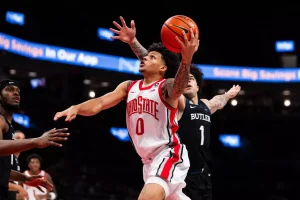
Ohio State basketball outscored Butler 23-6 in fast-break points. Jake Diebler and John Mobley Jr. see potential in the Buckeyes’ transition offense.
Ohio State’s improved athleticism showed in its 82-73 exhibition win over Butler on Sunday, especially when the Buckeyes turned defensive stops into scoring opportunities at the other end. The ability to push the pace, attack the basket, and create plays in the open floor gives Jake Diebler another weapon heading into the regular season.
Ohio State outscored Butler 23-6 in fast-break points, recorded eight blocks and seven steals, and capitalized on its athletic advantages. Amare Bynum led the Buckeyes with 23 points, showing how his size, skill, and ability to finish around the basket can create problems for opposing defenses.
For Diebler, the transition game remains a work in progress, but Sunday’s performance showed signs of growth.
“We talked about being more disruptive defensively, and we got deflections, we got some steals, [I] thought we had some blocks that ignited us,” Diebler said.
The Buckeyes have emphasized creating more disruption on defense, knowing that steals, deflections, and altered shots can lead to opportunities before an opponent gets set. Against Butler, Ohio State used that activity to get out in open space and pressure the Bulldogs’ defense.
Amare Bynum with AUTHORITY 😤 https://t.co/DnR3OCl0ch
— Blake T. Biscardi (@BlakeBiscardi) October 25, 2026
Bynum was the clearest example. The sophomore finished with 23 points and six rebounds, shooting 7-of-10 from the field, 2-of-4 from three-point range and 7-of-7 at the free-throw line. His ability to run the floor, finish at the rim, and make plays in space gives Ohio State a versatile option when it wants to push the pace.
“Amare’s size and athleticism and skill combination, and the open floor, is pretty, pretty lethal,” Diebler said.
Bynum’s performance captures the versatility Ohio State wants on its roster. The Buckeyes have players who can create advantages with their size and mobility, making them harder to defend in transition.
John Mobley Jr. believes Ohio State’s ability to run starts with having multiple players who can initiate the offense. The junior guard pointed to conditioning and the number of playmakers on the floor as important factors in the team’s development.
“Anybody could push it, which is a big thing,” Mobley said.
Mobley specifically mentioned Bynum as an example of that flexibility, explaining that when a player like Bynum secures a rebound, he can take the ball up the floor himself. Ohio State doesn’t have to wait for a guard to collect the ball and start the offense, letting the Buckeyes attack before the defense can organize.
Mobley also noted that the team is crashing the glass, giving whoever secures the rebound an opportunity to push the pace. That approach can create more transition chances, particularly when Ohio State has multiple players running the floor and looking to get involved.
The Buckeyes’ defensive activity against Butler also created those opportunities. Ohio State finished with eight blocks and seven steals, disrupting the Bulldogs and creating chances to turn the corner quickly.
Still, Diebler knows the team has to do more than rely on its physical tools. The Buckeyes left opportunities on the floor against Butler, and the Buckeye coach acknowledged that their transition execution and overall defensive performance need to improve.
Ohio State also struggled to finish defensive possessions. Butler outrebounded the Buckeyes 42-33, grabbed 19 offensive rebounds and scored 19 second-chance points. Ohio State had only five offensive rebounds, and the Bulldogs’ ability to extend possessions limited the Buckeyes’ opportunities to get out and run.
The rebounding concerns matter especially for a team looking to make transition offense a strength. Securing a defensive rebound is often the first step toward pushing the ball, and giving opponents extra chances can disrupt the pace Ohio State wants to establish.
Diebler said the Buckeyes’ defensive communication and physicality on the glass were not good enough, despite progress in those areas during the preseason. “Their guards hurt us on the glass too much,” Diebler said.
Ohio State’s transition game also depends on what happens when the initial opportunity is not there. Diebler emphasized that improved athleticism and size cannot become a substitute for ball movement, quick decisions, and sound offensive execution.
“Our strength still, even with improved athleticism and size, is to keep the ball moving, make quick decisions,” Diebler said.
The Buckeyes occasionally became stagnant against Butler’s ball-screen coverage, allowing the defense to recover rather than forcing it to react to the next action. Diebler wants Ohio State to attack the paint, create an advantage, and keep the ball moving instead of settling for contested shots or overdribbling.
That approach will be important as the season begins. Transition opportunities can produce quick points, but opponents will inevitably get back on defense and force Ohio State to execute in the half-court. The Buckeyes need to be comfortable in both settings.
Mobley said the team has made progress throughout its three exhibition games, returning to film and practice after each performance to address areas that need work. He believes the Buckeyes are in a good position heading into the season, though he acknowledged that their practice execution must translate more consistently to games.
After sparking the Buckeyes off the bench with 12 points and hitting his first four three-pointers, LJ Smith talks about staying ready and doing whatever it takes to win. https://t.co/fL8H71ROKt
— The Silver Bulletin (@tSilverBulletin) October 25, 2026
The win over Butler showed encouraging signs, along with some pause points like rebounding. Still, Ohio State’s 23-6 advantage in fast-break points showed what its athleticism can produce when the defense creates opportunities and players push the ball with purpose.
Ohio State’s next step is consistency. If the Buckeyes improve their rebounding, maintain defensive intensity, and keep making quick decisions with the ball, their athleticism can become a reliable part of their offensive identity rather than an occasional advantage.
For Diebler, the challenge is getting those pieces to work together. How often the Buckeyes can do it against regular-season competition will help determine how much that improvement means.

Blake Biscardi serves as Co-Founder, Lead Reporter, and Senior Editor of The Silver Bulletin. He hosts the Buckeye Cadence podcast, where he breaks down Ohio State football and basketball with an inside look into the programs. Covering Julian Sayin in New York City in 2025 was his Heisman moment, which became a viral moment in its own right. Biscardi is a member of the Football Writers Association of America (FWAA) and has degrees in Business Administration and Strategic Communication & Leadership.
Discover more from The Silver Bulletin
Subscribe to get the latest posts sent to your email.