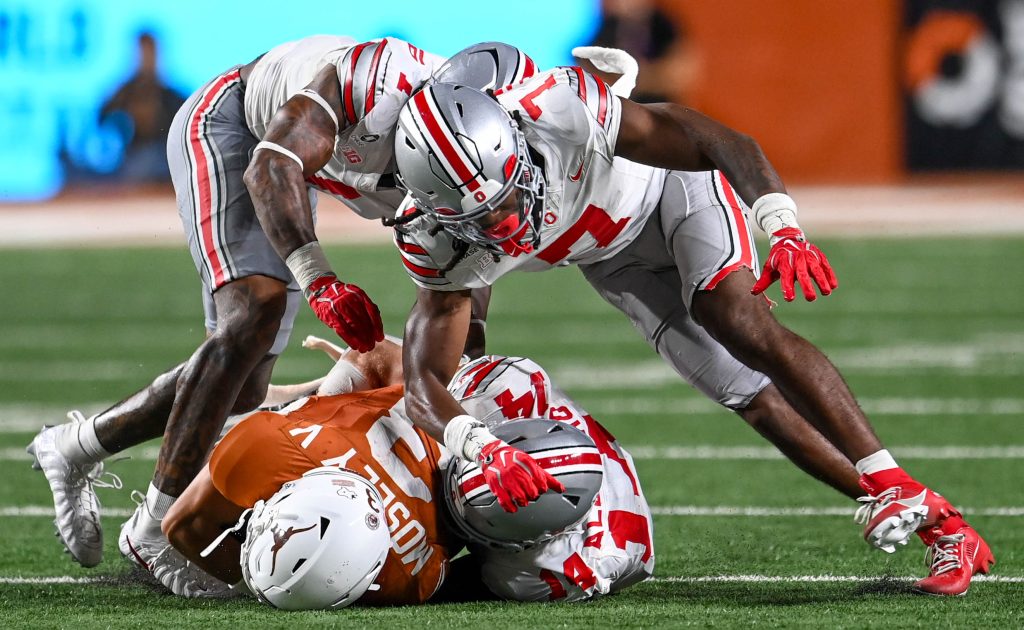
Ohio State’s offense continues to struggle in critical situations as third-down failures, missed reads, and execution issues raise concerns.
As Ohio State enters conference play this Saturday, a handful of question marks urgently need answers. With a loss already and five top-18 opponents remaining on the schedule, the Buckeyes’ margin for error has shrunk dramatically. A few areas stand out most.
Pass Rush Woes
This is perhaps Ohio State’s most glaring issue after three weeks. The ability to get true pressure on the quarterback has been inconsistent and largely ineffective. Kenyatta Jackson Jr. has done what was expected of him, especially since teams can key in on him, but that’s also the issue.
Without a second threat off the edge, opponents can neutralize Kenyatta more easily. Guys like Qua Russaw and Beau Atkinson have gotten opportunities but haven’t seized them. Christian Alliegro and Payton Pierce have taken snaps at the hybrid edge spot, but it’s hard to gauge whether or not that’s a long-term solution. Alliegro spoke about the shortcomings during his Tuesday availability:
“We’ve only had four sacks. Texas was a team that liked to get the ball out of the perimeter and get the ball out quick, Alliegro said. I think once we have more of, like, pocket-passing quarterbacks, we’ll be able to get there more…we got to keep them on third and longs so we can get sacks and stuff like that and create more pressure.”
The interior line isn’t without blame either. Eddrick Houston hasn’t lived up to expectations given his prospect ranking, physical attributes, and fall-camp performance. James Smith is most likely out with an arm injury for an extended period. Will Smith Jr., Jason Moore, and John Walker are dependable linemen, but they largely lack the raw ability to rush the passer in the same way Houston and Smith do. Over the long haul, the big guys up the middle will also have to carry their weight on pass downs.
There is, however, some hope for this area of weakness. Freshman DE Khary Wilder has been a notable bright spot on the defense since game one. Head coach Ryan Day has said they prefer to keep him in the 3rd-down rusher role for now, but with the pass-rush woes not improving, Day and his staff may have to consider expanding Wilder’s role.
Ryan Day spoke about the pass rush and blitzing during his Tuesday press conference: “When it’s time to go win the game in the fourth quarter, we have to be able to go win the game when it’s time, on both sides of the ball.” The Buckeyes also have multiple personnel and packing options, which Day noted.
“If that means playing zone, we’ll play zone. If that means playing man, then we’ll play man. If that means blitzing, then we gotta be able to do that. We gotta be able to win,” Day said.
Explosive Runs
Ohio State’s run game got off to a slow start to the year, but its work through three games has been effective enough. After all, Bo and Ja’Kobi Jackson have combined for 380 yards at 6.5 yards per carry. The only caveat is that two of the three games Ohio State has played were against MAC opponents.
Additionally, OSU’s explosive runs have been dormant since week one. The Buckeyes have just two runs of 12+ yards in the past two games, and only a handful of 10+ on the season.
Generating more explosive runs was a major offseason emphasis. Coach Day mentioned multiple times wanting a back who could “take over games.” Although the run game has been solid, nobody in the RB room has quite shown that ability yet this season.
“But when it comes to the second level, I think that there’s been signs in the first two games that was very good, not in this past game when you watch the film. So that’s a challenge to them,” Day said. But we got to get better in those areas. I thought we had some really good big holes in the game, and those should have been explosive plays, and they weren’t.
Day also mentioned challenging his running back room to “run angry” this week as they look to increase their physicality into conference play. Running back Ja’Kobi Jackson explained what running angry means to him, sharing, “Running angry really just looks like not being tackled one-on-one, open field, and winning, making the first guy miss, you know, not being tackled by the first guy.”
Jackson also pointed to execution being the stopping point for the running backs, especially in short yardage. He said in those moments, it’s about “just getting downhill, getting those yards, and reading the gaps.” Some of the ownership is on the running backs, while the rest is on the offensive line, because the combination makes the run game effective.
Situational Execution
Just one week removed from a collapse in Austin, Texas, where Ohio State came up short numerous times in crunch time, the Buckeyes’ first-team offense went 0-for-5 on third down against Kent State. Julian Sayin also failed to identify open receivers on fourth down multiple times.
The Ohio State offense has developed a troubling pattern on critical downs. Sayin has missed opportunities, but the problems extend beyond the quarterback. Pass protection, play design, missed assignments, and execution have all contributed to an offense that has struggled to sustain drives when the margin for error shrinks.
Ryan Day acknowledged that inconsistency remains a concern for Sayin and the offense entering conference play.
“I think we all want a higher level of consistency,” Day said.
The Ohio State coach also pointed to Sayin’s responsibility within each play, emphasizing the need to trust his feet and deliver the football on time. Sayin’s fourth-down sack against Texas illustrated that issue, as Day said the quarterback “didn’t progress through that play very well.”
Those mistakes become more costly in third-down and red-zone situations, where Ohio State has failed to execute at an acceptable level. Day said the Buckeyes were 12-for-33 on third down and converted short-yardage opportunities below their standard.
“When we find ourselves in short yardage situations, we have to convert,” Day said. “I mean, that’s where games are won and lost.”
Ohio State’s situational execution requires improvement across the offense. Sayin must make better decisions, while the coaching staff and supporting personnel must create conditions for consistent success.

Visit https://nil.store/TSB and use code TSB for 15% off!

Grant Kincaid was born in Columbus, Ohio, and raised in Dayton. He serves as Creative Director and basketball contributor at The Silver Bulletin. At one point, Grant, a collegiate baseball player, also holds a B.A. in Management and Leadership Studies. Aside from the Buckeyes, he is an avid supporter of both the Cincinnati Reds and Bengals. His favorite Buckeyes include Braxton Miller, AJ Hawk, and Ted Ginn Jr.
Discover more from The Silver Bulletin
Subscribe to get the latest posts sent to your email.