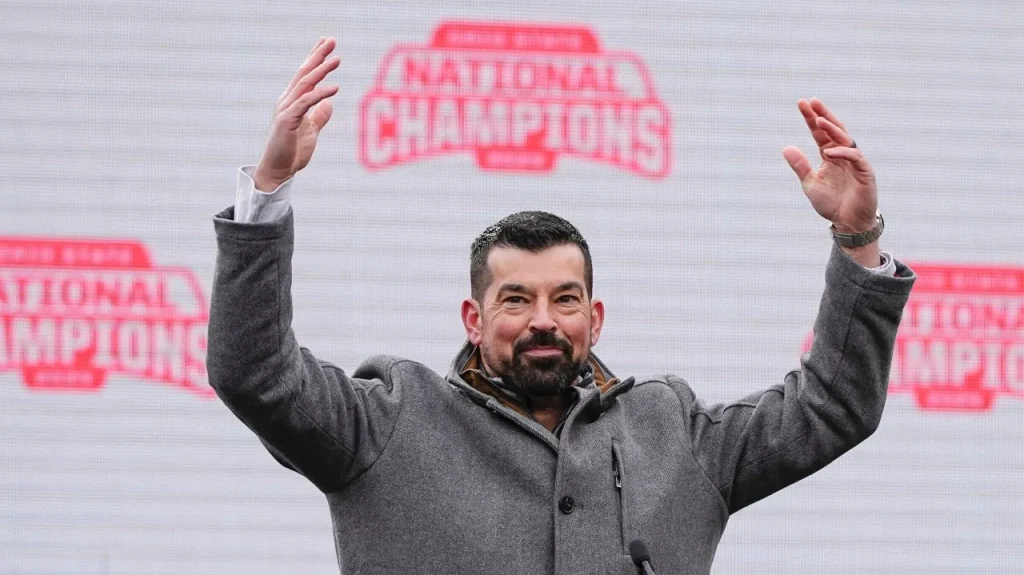
Getting the internal hire right is harder than any game the Buckeyes have ever played. Ryan Day and Ohio State made it look routine.
There is a version of the Ryan Day story that gets told often, and it goes something like this: Ohio State had a good thing going, Urban Meyer stepped away, the program handed the offense to the next man in line, and the machine kept running. It is a clean narrative that fits neatly into a pregame segment or a program retrospective, and it carries just enough truth to make it feel complete. However, it leaves out that promoting from within is not a formula, a guarantee, or a strategy.
The rarest win in college football is not the National Championship, though Day now has one. It is not the perfect season, though Day has come close. The rarest win in college football is finding the right internal hire and executing the transition from coordinator to head coach within the same program without losing the thread.
Then sustaining excellence that justifies the decision not just in Year 1 or Year 2 but across nearly a decade of recruiting cycles, staff changes, transfer portal chaos, and the relentless pressure that comes with coaching at a place that measures success in championships and rivalry wins. That win does not show up in any box score, and no one hands out a trophy for it, but it is the win that makes every other win possible.
College football’s history shows just how few programs have ever pulled it off like Ryan Day and Ohio State. He has done it with an 87.2% winning percentage over 94 games, which is a mark that currently ranks first among all FBS head coaches in the sport’s history. He has done it in the College Football Playoff era, when the margin between good and great has never been thinner, and the consequences of a single bad loss can unravel an entire season’s worth of work in the span of three hours on a Saturday afternoon.
He has done it while replacing a three-time national champion in a way that makes the whole scenario look effortless, which may be the most dangerous thing about it, because routine is what this never was and almost never is.
Consider the landscape of internal coordinator promotions at the Power Five level since 2000, and what you find is a spectrum of outcomes, not a collection of success stories. There have been hundreds of head coaching moves in the last twenty-five years, but only a small percentage have chosen the internal-hire route.
Here’s a comparison of the top 10 internal promotions since 2000 and why that path is the most challenging for sustained success. Some coaches catch lightning in a bottle right after the transition, but few elevate the program to further heights like Ryan Day.
Top Internal Coordinator Promotions (2000-present)
1. Ryan Day | Ohio State | OC → HC (2019-present)
Record: 82-12 | Win%: 87.2% | Grade: A+
Championships: 1 National Title, 5 CFP appearances
Conference Hardware: 2 Big Ten titles
Let’s take a look at the rest of the list to see how other internal promotions have turned out across the country.
2. Dabo Swinney | Clemson | WR Coach/Asst. HC → HC (2009-present)
Record: 187-53 | Win%: 77.9% | Grade: A+
Championships: 2 National Titles, 9 ACC titles, 7 CFP appearances
Conference Hardware: 9 ACC Championships
Dabo Swinney built a dynasty at Clemson after being promoted from a non-coordinator role in 2008, and his two national championships and nine ACC titles make him the only name on the list whose sustained excellence can be compared to what Day has built in Columbus. It appears he’s entered a late-career decline but remains one of the greats.
3. Jimbo Fisher | Florida State | OC/HC-in-Waiting → HC (2010-17)
Record: 83-23 (FSU) | Win%: 78.3% | Grade: A
Championships: 1 National Title, 3 ACC titles
Conference Hardware: 3 ACC Championships
One of the cleanest transitions in this study, Jimbo Fisher succeeded Bobby Bowden and won a national title in 2013 before the program collapsed around him. His subsequent tenure at Texas A&M became one of the more expensive lessons in modern college football history about the difference between inheriting a culture and actually building one.
4. Lincoln Riley | Oklahoma | OC → HC (2017-21)
Record: 55-10 (OU) | Win%: 84.6% | Grade: A
Championships: 4 Big 12 titles, 3 CFP appearances
Conference Hardware: 4 Big 12 Championships
Lincoln Riley dominated the Big 12 at Oklahoma for four seasons and produced back-to-back Heisman Trophy winners before moving out west to USC, where his win percentage sits at .660 compared to .846 in Norman. Notably, Caleb Williams followed Riley to Los Angeles and won the Heisman in 2022, giving Riley his third winner.
5. Marcus Freeman | Notre Dame | DC → HC (2022-present)
Record: 43-12 | Win%: 78.2% | Grade: B+
Championships: 2025 CFP National Championship game appearance
Conference Hardware: Independent
Marcus Freeman started his Notre Dame tenure 0-3, but emerged on the other side as a legitimate national title contender, advancing to the championship game in 2024 before falling to Ohio State in a game that added one more line to Day’s legacy. Freeman has one of the best teams in the country in 2026 and can make a serious climb up the list.
6. Kyle Whittingham | Utah | DC → HC (2005-25)
Record: 177-88 (Utah) | Win%: 66.8% | Grade: B+
Championships: 2 Pac-12 titles, Sugar Bowl win over Alabama
Conference Hardware: 2 Pac-12 Championships (2021, 2022)
Quietly, one of the best internal hires in modern college football history. Kyle Whittingham replaced Urban Meyer and never let the program slip. He compiled the most wins in Utah history over 21 seasons before leaving for Michigan in 2025.
7. Mike Gundy | Oklahoma State | OC/Asst. HC → HC (2005-25)
Record: 170-90 | Win%: 65.4% | Grade: B+
Championships: 1 Big 12 title, 8 ten-win seasons
Conference Hardware: 1 Big 12 Championship (2011)
Mike Gundy went 5-7 in his first season at Oklahoma State in 2005 and still built a 20-season run that transformed OSU football. One of the most underrated coaching careers in Big 12 history, but the program never scaled the same heights again after 2021. Back-to-back losing seasons ended his run in 2025.
8. David Shaw | Stanford | OC → HC (2011)
Record: 96-54 | Win%: 64.0% | Grade: B
Championships: 3 Pac-12 titles, 3 Rose Bowl appearances
Conference Hardware: 3 Pac-12 Championships
David Shaw replaced Jim Harbaugh and looked like one of the great hires, and went 34-7 in his first three seasons at Stanford and won three straight Pac-12 titles before the program deteriorated, leading to his resignation with a 14-28 record over his final four years
9. Sherrone Moore | Michigan | OC/OL Coach → HC (2024)
Record: 17-8 | Win%: 68.0% | Grade: Incomplete
Championships: None
Conference Hardware: None
Gone almost before it started. Sherrone Moore went 8-5 and 9-3 in two seasons but was fired for cause in December 2025 amid an investigation into an inappropriate relationship with a staffer. On-field results were mediocre coming off a national title, and off-field conduct ended the story.
10. Jimmy Lake | Washington | DC → HC (2020)
Record: 7-6 | Win%: 53.8% | Grade: F
Championships: None
Conference Hardware: None
Jimmy Lake at Washington, whose 13-game tenure serves as a reminder that internal promotions carry catastrophic downside risk. Lake was handpicked by Chris Petersen, a coach who understood Washington’s culture, and he was promoted because he seemed to embody everything the program valued. He lasted less than two full seasons before being suspended and then fired for shoving a player on the sideline during a game, leaving the program to spend the next several years rebuilding what his brief tenure had unraveled.
25 Years of Data
What the subsequent years have sorted out at Ohio State belongs in a category almost entirely of its own. Day not only held the line that Urban Meyer established, but he surpassed it, delivering the program’s first national championship since 2014 and doing it in the College Football Playoff era against a field of competition that Meyer never had to navigate at the same level of depth and difficulty.
Day did it while developing quarterbacks at a level that has become the national standard, recruiting classes that consistently rank among the best in the country, and managing program-wide expectations that turn some coaches into cautionary tales and great ones into something the sport rarely gets to see.
The reason no one talks about how hard this was is the same reason no one talks about how hard anything looks in retrospect when the person doing it makes it appear effortless. Ohio State promoted from within, the story goes, and it worked. Ryan Day is an elite coach, and the program is in good hands, which is more or less the end of the conversation.
However, the conversation deserves more space, because the history of internal promotions in this sport is not always a story about how well the formula works. It is a story about how rarely it works at all, how many careers it has swallowed, how many programs it has set back by two or three recruiting cycles, and how narrow the path between getting it right and getting it wrong has always been.
Ohio State found the one coach in this era who walked that path without flinching. That is the win that does not show up on any scoreboard, and it is the rarest in college football.

Blake Biscardi serves as Co-Founder, Lead Reporter, and Senior Editor of The Silver Bulletin. He hosts the Buckeye Cadence podcast, where he breaks down Ohio State football and basketball with an inside look into the programs. Covering Julian Sayin in New York City in 2025 was his Heisman moment, which became a viral moment in its own right. Biscardi is a member of the Football Writers Association of America (FWAA) and has degrees in Business Administration and Strategic Communication & Leadership.
Discover more from The Silver Bulletin
Subscribe to get the latest posts sent to your email.